the human eye and the colourful world — Science STD 10 — Question
Gujarat BoardEnglish MediumSTD 10Sciencethe human eye and the colourful world4 Marks
Question
How is a normal eye able to see distinctly, distant as well as nearby objects?
✓
Answer
The eye lens is composed of a fibrous, jelly-like material. Its curvature can be changed (modified) to some extent by the ciliary muscles. The change in the curvature of the eye lens can thus change its focal length.
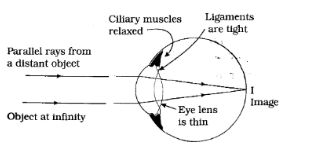
The ciliary muscles are relaxed while observing distant objects such as a distant tree (at infinity). In this case, the eye lens is thin. Hence, it has maximum focal length and minimum converging power. An inverted image of the distant object is formed on the retina.
Thus, the eye is in relaxed state while observing distant objects. (It is said to be unaccommodated.)
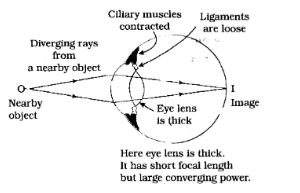
The ciliary muscles contract while observing nearby objects (such as a book at $25 ~cm$ from the eye). In this case, the thickness of eye lens increases radii ‘of curvature of its surfaces decrease. Hence, the focal length of the lens decreases and converging power increases. An inverted image of the nearby object is formed on the retina.
(Thus, the eye feels uneasy while observing nearby objects. It is said to be accommodated.)
Need a full question paper?
Generate a complete, print-ready paper with questions like this in minutes — across 16+ boards, with answer keys.