Question
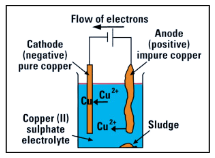
How is copper obtained from its ore $(Cu_2S)$? Write only the chemical equations. How is copper thus obtained refined? Name and explain the process alongwith a labelled diagram.
Answer

Copper is obtained from its ore Copper glance $(Cu_2S)$ in two steps$:$
$2 Cu _2 S( s )+3 O _2(g) \xrightarrow{\text { Heat }} 2 Cu _2 O ( s )+2 SO _2(g)$
$2 Cu _2 O ( s )+ Cu _2 S( s ) \xrightarrow{\text { Heat }} 6 Cu ( s )+ SO _2(g)$
The Copper thus obtained is refined by the process called "Electrolytic Refining". In this, the impure copper is made anode by connecting to the positive terminal of the battery and a thin plate of pure copper is made cathode by connecting to the negative terminal of the battery. The copper sulphate $($acidified$)$ solution is taken in the tank which acts as an electrolyte. When an electric current is passed through the solution, the pure copper from the anode passes into the solution and an equivalent amount of $Cu^+$ ions from the solution are deposited on the cathode as pure copper. Impure copper usually contains the impurities $\text{(Fe, Ag, Au)}$ which collects below the anode as "Anode mud".
At cathode $: Cu ^{2+}( aq )+2 e ^{-} \rightarrow Cu ( s )$
At anode $: Cu ( s ) \rightarrow Cu ^{2+}( aq )+2 e ^{-}$
The diagram shown below is of electrolytic refining of copper

Image

Need a full question paper?

Generate a complete, print-ready paper with questions like this in minutes — across 16+ boards, with answer keys.

Start Generating Free

Similar questions

State and explain the Clock face rule for determining the polarities of a circular wire carrying current.
Explain why, a solution of cane sugar does not conduct electricity but a solution of common salt is a good conductor of electricity.
Using electron-dot diagrams which show only the outermost shell electrons, show how a molecule of nitrogen, N, is formed from two nitrogen atoms. What name is given to this type of bonding? (Atomic number of nitrogen is 7)
Sudha finds out that the sharp image of the window pane of her science laboratory is formed at a distance of 15cm from the lens. She now tries to focus the building visible to her outside the window instead of the window pane without disturbing the lens. In which direction will she move the screen to obtain a sharp image of the building? What is the approximate focal length of this lens?
Human body is made up of five important components, of which water is the main component. Food as well as potable water are essential for every human being. The food is obtained from plants through agriculture. Pesticides are being used extensively for a high yield in the fields. These pesticides are absorbed by the plants from the soil along with water and minerals and from the water bodies these pesticides are taken up by the aquatic animals and plants. As these chemicals are not biodegradable, they get accumulated progressively at each trophic level. The maximum concentration of these chemicals gets accumulated in our bodies and greatly affects the health of our mind and body.
  1. Why is the maximum concentration of pesticides found in human beings?
  2. Give one method which could be applied to reduce our intake of pesticides through food to some extent.
  3. Various steps in a food chain represent:
  1. Food web.
  2. Trophic level.
  3. Ecosystem.
  4. Biomagnification.
  1. With regard to various food chains operating in an ecosystem, man is a:
  1. Consumer.
  2. Producer.
  3. Producer and consumer.
  4. Producer and decomposer.
You are provided with two lenses of focal length 20cm and 30cm, respectively. Which lens will you use to obtain more convergent light?
Give names of the following:
  1. An alcohol containing 5-carbon atoms.
  2. On acid with 4-carbon atoms.
  3. Simplest aldehyde.
Two ores A and B were taken. On heating ore A gives $CO _2$ whereas, ore B gives $SO _2$. What steps will you take to convert them into metals?
What is meant by human circulatory system? Name the organs of the circulatory system in humans.
An object 4cm high is placed at a distance of 10cm from a convex lens of focal length 20cm. Find the position, nature and size of the image.