Question
How is galvanometer converted into a voltmeter?

Answer

A galvanometer can be converted into voltmeter of given range by connecting a high resistance called multiplier in series with the galvanometer, whose value is given as: $\text{R}\Big(\frac{\text{V}}{\text{I}_\text{g}}\Big)-\text{G}$
Where $V$ is the voltage to be measured, $I_g$ is the current for full scale deflection of galvanometer and $G$ is the resistance of galvanometer.

Need a full question paper?

Generate a complete, print-ready paper with questions like this in minutes — across 16+ boards, with answer keys.
Start Generating Free

Similar questions

In the hysteresis cycle, the value of H needed to make the intensity of magnetisation zero is called(a) Retentivity(b) Coercive force(c) Lorentz force(d) None of the above
       
An electron $($mass $= 9.1 \times 10^{-19} \mathrm{~kg} ;$ charge $=1.6 \times 10^{-19} C)$ experiences no deflection if subjected to an electric field of $3.2 \times 10^5 \mathrm{V} / \mathrm{m},$ and a magnetic fields of $2.0 \times 10^{-3}\ \mathrm{Wb} / \mathrm{m}^2.$ Both the fields are normal to the path of electron and to each other. If the electric field is removed, then the electron will revolve in an orbit of radius
A magnifying glass is used, as the object to be viewed can be brought closer to the eye than the normal near point. This results in;
An electron microscope is superior to an optical microscope in(a) Having better resolving power  (b) Being easy to handle  (c) Low cost  (d) Quickness of observation 
   
   
A charged particle moves along a circle under the action of possible constant electric and magnetic fields. Which of the following are possible?
A sonometer wire supports a $4\ kg$ load and vibrates in fundamental mode with a tuning fork of frequency $416\ Hz.$ The length of the wire between the bridges is now doubled. In order to maintain fundamental mode, the load should be changed to:
In an A.C. circuit, the current flowing in inductance is $\text{I}=5\sin\Big(\frac{100-\text{t}-\pi}{2}\Big)$ ampers and the potential difference is $\text{V}=200\sin(100\text{t})$ volts. The power consumption is equal to.
The number of dry cells, each of e.m.f. 1.5 volt and internal resistance 0.5 ohm that must be joined in series with a resistance of 20 ohm so as to send a current of 0.6 ampere through the circuit is(a) 2 (b) 8(c) 10       (d) 12
       
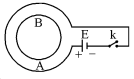
In the given figure, when key k is closed, then direction of induced current in the coil B IS:
Image
The binding energy per nucleon of deuterium and helium atom is 1.1 MeV and 7.0 MeV. If two deuterium nuclei fuse to form helium atom, the energy released is(a) 19.2 MeV(b) 23.6 MeV(c) 26.9 MeV(d) 13.9 MeV