Question
How is Lenz's law based on conservation of energy ?

Answer

Lenz's law states that the polarity of induced emf is such that it tends to produce a current with opposes the change in magnetic flux that produces it.
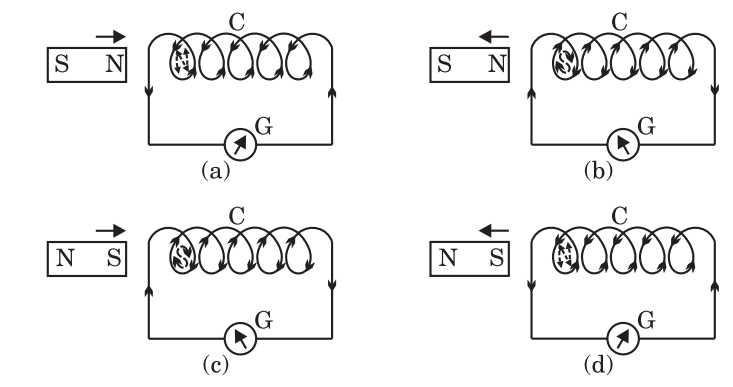
The following experiment shows that Lenz's law is based on conservation of energy. The experiment is carried out with a bar magnet NS and a coil C connected to a sensitive galvanometer G as shown in the adjoining figure.
When the bar magnet is suddenly moved towards the coil pointing its N pole towards the coil, galvanometer indicates deflection showing that the electric current is flowing in the coil [Fig. (a)]. If the motion of the magnet ceases, the needle of the galvanometer returns to zero mark indicating that the current in the coil has stopped. If the magnet is carried away from the coil quickly the galvanometer shows a deflection but in the opposite direction to that of Fig. (a) [Fig. (b)]. When the bar magnet is suddenly moved towards or away from the coil pointing its S pole towards the coil the deflection in the galvanometer is opposite to that observed in fig. (a) and fig. (b) respectively. This is shown in fig. (c) and fig. (d), respectively.
Image
In this experiment, it is clear that in each case in order to move the bar magnet some mechanical work has to be done against the opposing force and the electrical energy obtained is the coil is equivalent to this work obeying law of conservation of energy.
It should also be noted here that if the direction of induced current in the coil does not oppose the motion of the magnet, then electric energy will be obtained without doing any work which is impossible. Hence Lenz's law is in accordance with law of conservation of energy.
Need a full question paper?

Generate a complete, print-ready paper with questions like this in minutes — across 16+ boards, with answer keys.

Start Generating Free

Similar questions

A person goes to bed at sharp 10:00 pm every day. Is it an example of periodic motion? If yes, what is the time period? If no, why?
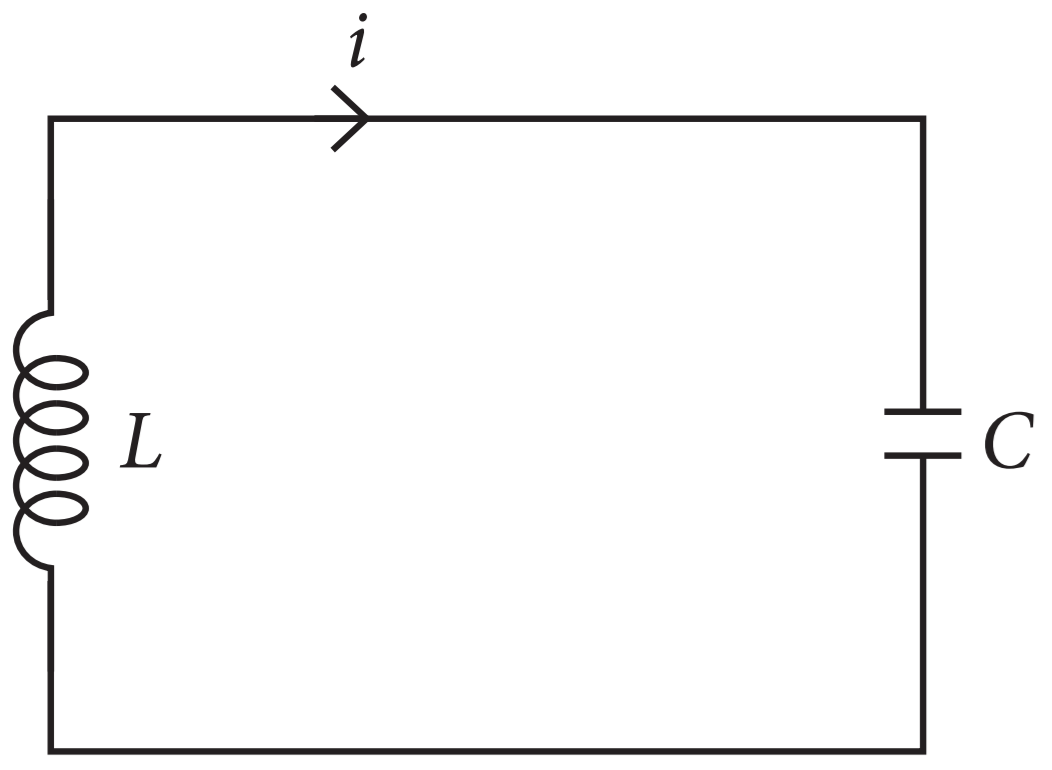
An $LC$ circuit also called a resonant circuit, tank circuit or tuned circuit is an electric circuit consisting of an inductor represented by the letter Land a capacitor, represented by the letter $C$ connected together. An $LC$ circuit is an idealized model since it assumes there is no dissipation of energy due to resistance. An $LC$ circuit contains a $20mH$ inductor and a $50\mu\text{F}$ capacitor with an initial charge of $10mC$. The resistance of the circuit is negligible. Let the instant the circuit is closed bet $= 0$.
  1. The total energy stored initially is:
  1. $5J$
  2. $3J$
  3. $10J$
  4. $1J$
  1. The natural frequency of the circuit is:
  1. $159.24Hz$
  2. $200.12Hz$
  3. $110.25Hz$
  4. $95Hz$
  1. At what time is the energy stored completely electrical?
  1. $0, 5\text{T}, 9\text{T}$
  2. $0,\text{T}, 2\text{T}, 3\text{T}$
  3. $\frac{\text{T}}{2},\frac{\text{5T}}{2},\frac{\text{9T}}{2}$
  4. $0,\frac{\text{T}}{2},{\text{T}},\frac{\text{3T}}{2}$
  1. At what time is the energy stored completely magnetic?
  1. $\frac{\text{T}}{2},\frac{\text{3T}}{2},\frac{\text{T}}{4}$
  2. $\frac{\text{T}}{3},\frac{\text{T}}{9},\frac{\text{T}}{12}$
  3. $0, 2\text{T}, 3\text{T}$
  4. $\frac{\text{T}}{4},\frac{\text{3T}}{4},\frac{\text{5T}}{4}$
  1. The value of $X_L$ is:
  1. $20\Omega$
  2. $40\Omega$
  3. $60\Omega$
  4. $50\Omega$
A hot body is placed in a closed room maintained at a lower temperature. Is the number of photons in the room increasing?
An electromagnetic wave transports linear momentum as it travels through space. If an electromagnetic wave transfers a total energy $U$ to a surface in time $t,$ then total linear momentum delivered to the surface is $\text{p}=\frac{\text{U}}{\text{c}}.$ When an electromagnetic wave falls on a surface, it exerts pressure on the surface. ln $1903,$ the American scientists Nichols and Hull succeeded in measuring radiation pressures of visible light where other had failed, by making a detailed empirical analysis of the ubiquitous gas heating and ballistic effects.
  1. The pressure exerted by an electromagnetic wave of intensity $I (Wm^{-2})$ on a non$-$reflecting surface is $(c$ is the velocity of light$).$ 
  1. $\text{Ic}$
  2. $\text{Ic}^2$
  3. $\frac{\text{I}}{\text{c}}$
  4. $\frac{\text{I}}{\text{c}^2}$
  1. Light with an energy flux of $18\frac{\text{W}}{\text{cm}^2}$ falls on a non$-$reflecting surface at normal incidence. The pressure exerted on the surface is:
  1. $3\frac{\text{N}}{\text{m}^2}$
  2. $2\times10^{-4}\frac{\text{N}}{\text{m}^2}$
  3. $6\frac{\text{N}}{\text{m}^2}$
  4. $6\times10^{-4}\frac{\text{N}}{\text{m}^2}$
  1. Radiation of intensity $0.5Wm^{-2}$ are striking a metal plate. The pressure on the plate is:
  1. $0.166 \times 10^{-8}Nm^{-2}$
  2. $0.212 \times 10^{-8}Nm^{-2}​​​​​​​$
  3. $0.132 \times 10^{-8}Nm^{-2}​​​​​​​$
  4. $0.083 \times 10^{-8}Nm^{-2}​​​​​​​$
  1. A point source of electromagnetic radiation has an average power out$-$put of $1500W.$ The maximum value of electric field at a distance of 3m from this source $($in $Vm^{-1})$ is:
  1. $500$
  2. $100$
  3. $\frac{500}{3}$
  4. $\frac{250}{3}$
  1. The radiation pressure of the visible light is of the order of,
  1. $10^{-2}\frac{\text{N}}{\text{m}^2}$
  2. $10^{-4}\frac{\text{N}}{\text{m}}$
  3. $10^{-6}\frac{\text{N}}{\text{m}^2}$
  4. $10^{-8}\text{N}$
Describe with diagram the working method of $p-n-p$ and $n-p-n$ transistors.
In an electromagnetic wave both the electric and magnetic fields are perpendicular to the direction of propagation, that is why electromagnetic waves are transverse in nature. Electromagnetic waves carry energy as they travel through space and this energy is shared equally by the electric and magnetic fields. Energy density of an electromagnetic waves is the energy in unit volume of the space through which the wave travels.
  1. The electromagnetic waves propagated perpendicular to both $\vec{\text{E}}$ and $\vec{\text{B}}.$ The electromagnetic waves travel in the direction of.
  1. $\vec{\text{E}}\times\vec{\text{B}}$
  2. $\vec{\text{E}}\times\vec{\text{B}}$
  3. $\vec{\text{B}}\times\vec{\text{E}}$
  4. $\vec{\text{B}}\times\vec{\text{E}}$
  1. Fundamental particle in an electromagnetic wave is:
  1. Photon
  2. Electron
  3. Phonon
  4. Proton
  1. Electromagnetic waves are transverse in nature is evident by:
  1. Polarisation
  2. Interference
  3. Reflection
  4. Diffraction
  1. For a wave propagating in a medium, identify the property that is independent of the others.
  1. Velocity
  2. Wavelength
  3. Frequency
  4. All these depend on each other.
  1. The electric and magnetic fields of an electromagnetic waves are:
  1. In opposite phase and perpendicular to each other.
  2. In opposite phase and parallel to each other.
  3. In phase and perpendicular to each other.
  4. In phase and parallel to each other.
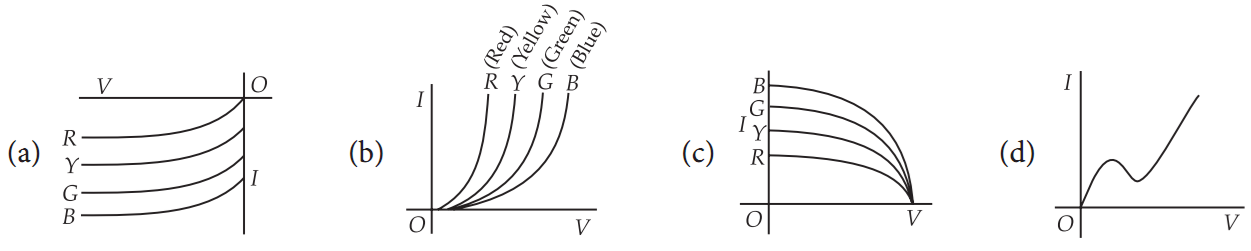
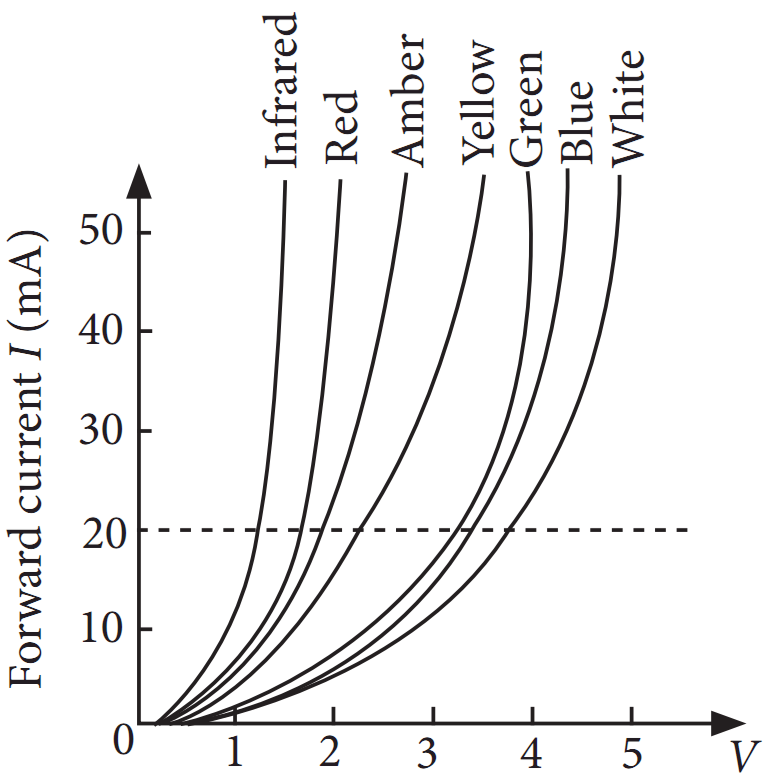
Light emitting diode is a photoelectric device which converts electrical energy into light energy. It is a heavily doped $p-n$ junction diode which under forward biased emits spontaneous radiation. The general shape of the $I-V$ characteristics of an $\text{LED}$ is similar to that of a normal $p-n$ junction diode, as shown. The barrier potentials are much higher and slightly different for each colour.
  1. The $I-V$ characteristic of an $\text{LED}$ is:
  1. The schematic symbol of light emitting diode is $\text{(LED)}.$
  1. An $\text{LED}$ is constructed from a p-n junction based on a certain $Ga-$ As $-P$ semiconducting material whose energy gap is $1.9eV$. Identify the colour of the emitted light.
  1. Blue.
  2. Red.
  3. Violet.
  4. Green.
  1. Which one of the following statement is not correct in the case of light emitting diodes?
  1. It is a heavily doped $p-n$ junction.
  2. It emits light only when it is forward biased.
  3. It emits light only when it is reverse biased.
  4. The energy of the tight emitted is less than the energy gap of the semiconductor used.
  1. The energy of radiation emitted by $\text{LED}$ is:
  1. Greater than the band gap of the semiconductor used.
  2. Always less than the band gap of the semiconductor used.
  3. Always equal to the band gap of the semiconductor used.
  4. Equal to or less than the band gap of the semiconductor used.
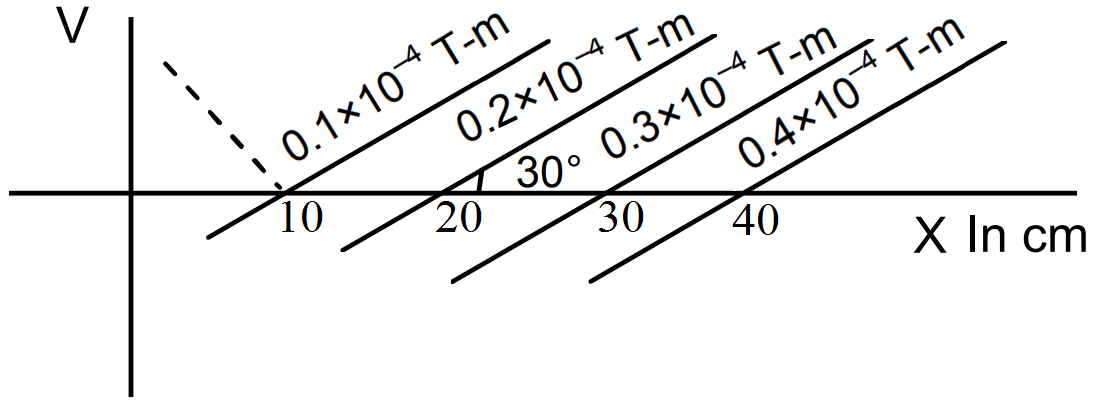
Figure shows some of the quipotential surfaces of the magnetic scalar potential. Fmd the magnetic field $B$ at a point in the region.
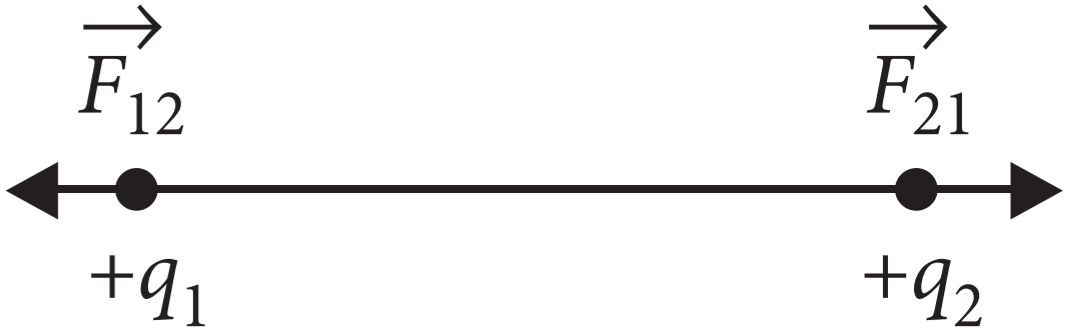
Coulomb's law states that the electrostatic force of attraction or repulsion acting between two stationary point charges is given by : $\text{F}=\frac{1}{4\pi\epsilon_0}\frac{\text{q}_1\text{q}_2}{\text{r}^2}$

Where $F$ denotes the force between two charges $q_1$ and $q_2$ separated by a distance $r$ in free space, $\epsilon_0$ is a constant known as permittivity of free space. Free space is vacuum and may be taken to be air practically. If free space is replaced by a medium, then $\epsilon_0$ is replaced by $(\epsilon_0\text{k})$ or $(\epsilon_0\epsilon_\text{r})$ where $k$ is known as dielectric constant or relative permittivity.
  1. In coulomb's law, $\text{F}=\text{k}\frac{\text{q}_1\text{q}_2}{\text{r}^2}$ then on which of the following factors does the proportionality constant $k$ depends?
  1. Electrostatic force acting between the two charges.
  2. Nature of the medium between the two charges.
  3. Magnitude of the two charges.
  4. Distance between the two charges.
  1. Dimensional formula for the permittivity constant $\epsilon_0$ of free space is:
  1. $[ML^{-3 }T^4 A^2]$
  2. $[M^{-1} L^3 T^2 A^2]$
  3. $[M^{-1} L^{-3} T^4 A^2]$
  4. $ML^{-3} T^4 A^{-2}]$
  1. The force of repulsion between two charges of $1C$ each, kept $1m$ apart in vaccum is:
  1. $\frac{1}{9\times10^9}\text{N}$
  2. $9 \times 10^9N$
  3. $9 \times 10^7N$
  4. $\frac{1}{9\times10^{12}}\text{N}$
  1. Two identical charges repel each other with a force equal to $10$ mgwt when they are $0.6m$ apart in air.$(g = 10m s^{-2})$. The value of each charge is:
  1. $2mC$
  2. $2 \times 10^{-7}mC$
  3. $2 nC$
  4. $2\mu\text{C}$
  1. Coulomb's law for the force between electric charges most closely resembles with:
  1. Law of conservation of energy.
  2. Newton's law of gravitation.
  3. Newton's $2^{nd}$ law of motion.
  4. Law of conservation of charge.
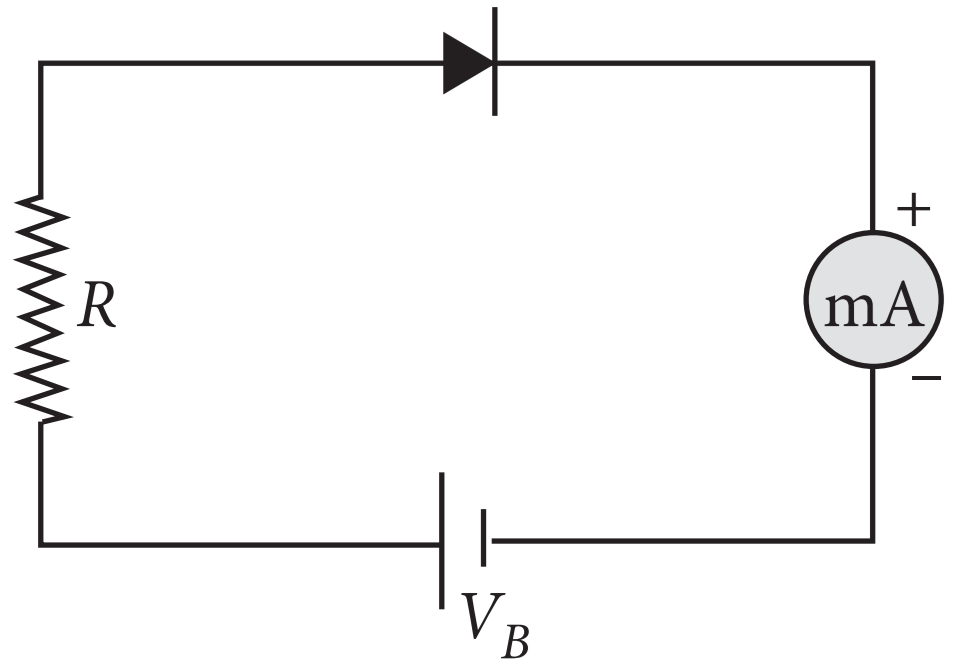
A silicon $p-n$ junction diode is connected to a resistor Rand a battery of voltage $V_B$ through milliammeter $(mA)$ as shown in figure. The knee voltage for this junction diode is $V_N = 0.7V$. The $p-n$ junction diode requires a minimum current of $1 mA$ to attain a value higher than the knee point on the $I-V$ characteristics of this junction diode. Assuming that the voltage Vacross the junction is independent of the current above the knee point. A $p-n$ junction is the basic building block of many semiconductordevices like diodes. Important process occurring during the formation of a $p-n$ junction are diffusion and drift. ln an $n-$type semiconductor concentration of electrons is more as compared to holes. ln a $p-$ type semiconductor concentration of holes is more as compared to electrons.
  1. If $V_{B }= 5V,$ the maximum value of $R$ so that the voltage $V$ is above the knee point voltage is:
  1. $40\text{k}\Omega$
  2. $4.3\text{k}\Omega$
  3. $5.0\text{k}\Omega$
  4. $5.7\text{k}\Omega$
  1. If $V_B = 5V,$ the value of $R$ in order to establish a current to $6mA$  in the circuit is:
  1. $833\Omega$
  2. $717\Omega$
  3. $950\Omega$
  4. $733\Omega$
  1. If $V_B = 6V,$ the power dissipated in the resistor $R,$ when a current of $6mA$ flows in the circuit is:
  1. $30.2mW$
  2. $30.8mW$
  3. $31.2mW$
  4. $31.8mW$
  1. When the diode is reverse biased with a voltage of $6V$ and $V_{bi} = 0.63V$. Calculate the total potential.
  1. $9.27V$
  2. $6.63V$
  3. $5.27V$
  4. $0.63V$
  1. Which of the below mentioned statement is false regarding a $p-n$ junction diode?
  1. Diodes are uncontrolled devices.
  2. Diodes are rectifying devices.
  3. Diodes are unidirectional devices.
  4. Diodes have three terminals.