Question
How is Lenz's law based on conservation of energy ?

Answer

Lenz's law states that the polarity of induced emf is such that it tends to produce a current with opposes the change in magnetic flux that produces it.
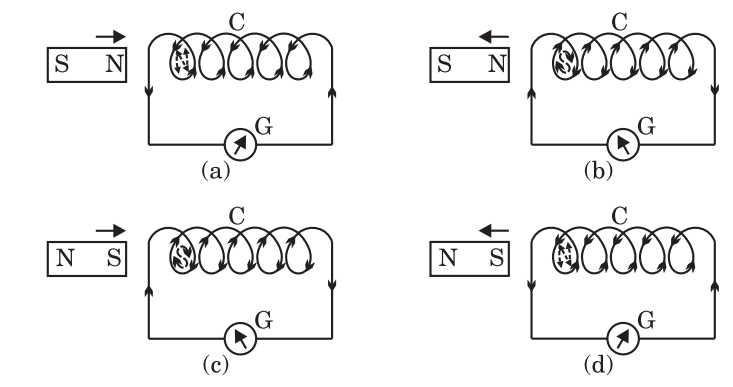
The following experiment shows that Lenz's law is based on conservation of energy. The experiment is carried out with a bar magnet NS and a coil C connected to a sensitive galvanometer G as shown in the adjoining figure.
When the bar magnet is suddenly moved towards the coil pointing its N pole towards the coil, galvanometer indicates deflection showing that the electric current is flowing in the coil [Fig. (a)]. If the motion of the magnet ceases, the needle of the galvanometer returns to zero mark indicating that the current in the coil has stopped. If the magnet is carried away from the coil quickly the galvanometer shows a deflection but in the opposite direction to that of Fig. (a) [Fig. (b)]. When the bar magnet is suddenly moved towards or away from the coil pointing its S pole towards the coil the deflection in the galvanometer is opposite to that observed in fig. (a) and fig. (b) respectively. This is shown in fig. (c) and fig. (d), respectively.
Image
In this experiment, it is clear that in each case in order to move the bar magnet some mechanical work has to be done against the opposing force and the electrical energy obtained is the coil is equivalent to this work obeying law of conservation of energy.
It should also be noted here that if the direction of induced current in the coil does not oppose the motion of the magnet, then electric energy will be obtained without doing any work which is impossible. Hence Lenz's law is in accordance with law of conservation of energy.
Need a full question paper?

Generate a complete, print-ready paper with questions like this in minutes — across 16+ boards, with answer keys.

Start Generating Free

Similar questions

A tungsten cathode and a thoriated-tungsten cathode have the same geometric dimensions and are operated at the same temperature. The thoriated-tungsten cathode gives 5000 times more current than the other cathode. Find the operating temperature. Take relevant data from the previous problem.
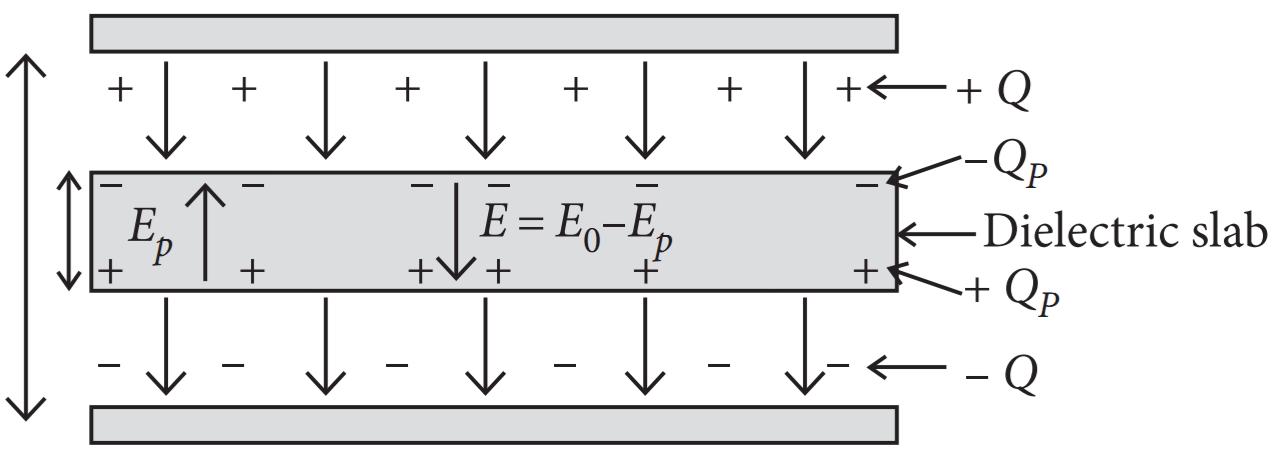
A dielectric slab is a substance which does not allow the flow of charges through it but permits them to exert electrostatic forces on one another.

When a dielectric slab is placed between the plates, the field E0 polarises the dielectric. This induces charge -QP on the upper surface and + QP on the lower surface of the dielectric. These induced charges set up a field EP inside the dielectric in the opposite direction of $\vec{\text{E}_0}$ as shown.

  1. ln a parallel plate capacitor, the capacitance increases from $4\mu\text{F}$ to $80\mu\text{F},$ on introducing a dielectric medium between the plates. What is the dielectric constant of the medium?
  1. 10
  2. 20
  3. 50
  4. 100
  1. A parallel plate capacitor with air between the plates has a capacitance of 8pE The separation between the plates is now reduced half and the space between them is filled with a medium of dielectric constant 5. Calculate the value of capacitance of the capacitor in second case.
  1. 8pF
  2. 10pF
  3. 80pF
  4. 100pF
  1. A dielectric introduced between the plates of a parallel plate condenser:
  1. Decreases the electric field between the plates.
  2. Increases the capacity of the condenser.
  3. Increases the charge stored in the condenser.
  4. Increases the capacity of the condenser.
  1. A parallel plate capacitor of capacitance 1 pF has separation between the plates is d. When the distance of separation becomes 2d and wax of dielectric constant x is inserted in it the capacitance becomes 2pE What is the value of x?
  1. 2
  2. 4
  3. 6
  4. 8
  1. A parallel plate capacitor having area A and separated by distanced is filled by copper plate of thickness b. The new capacity is:
  1. $\frac{\in_0\text{A}}{\text{d}+\frac{\text{b}}{2}}$

  2. $\frac{\in_0\text{A}}{\text{2d}}$

  3. $\frac{\in_0\text{A}}{\text{d-b}}$

  4. $\frac{2\in_0\text{A}}{\text{d}+\frac{\text{b}}{2}}$

A 4.0kg block is suspended from the ceiling of an elevator through a, string having a linear mass density of 19.2 × 10-3kg/m. Find the speed (with respect to the string) with which a wave pulse can proceed on the string if the elevator accelerates up at the rate of 2.0m/s2. Take g = 10m/s2.
Define self-inductance and write its S.I. unit. Find the self inductance for a solenoid of N turns, length $l$ and radius $r$.
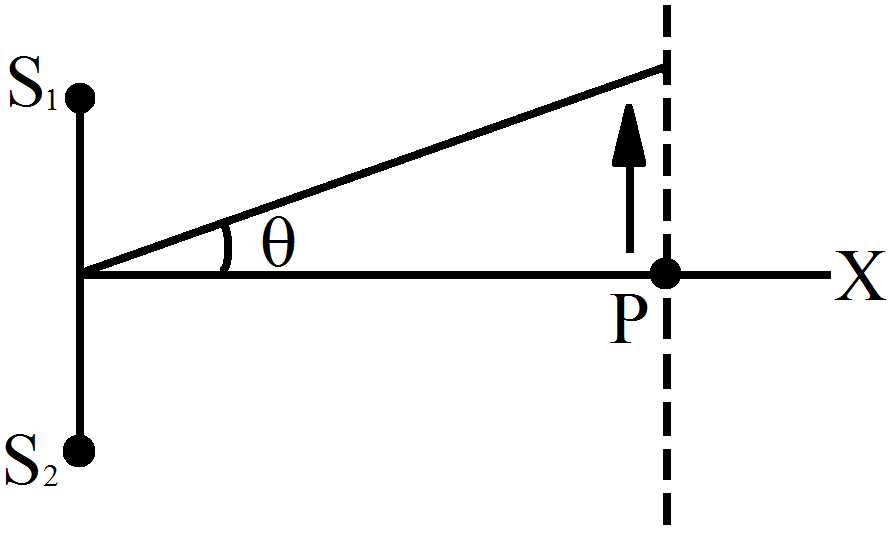
Two speakers S1 and S2, driven by the same amplifier, are placed at y = 1.0m and y = -1.0m figure, The speakers vibrate in phase at 600Hz. A man stands at a point on the X-axis at a very large distance from the origin and starts moving parallel to the Y-axis. The speed of sound in air is 330m/s.

  1. At what angle $\theta$ will the intensity of sound drop to a minimum for the first time?
  2. At what angle will he hear a maximum of sound intensity for the first time?
  3. If he continues to walk along the line, how many more maxima can he hear?

Shows a rod PQ of length 20.0cm and mass 200g suspended through a fixed point O by two threads of lengths 20.0cm each. A magnetic field of strength 0.500T exists in the vicinity of the wire PQ, as shown in the figure. The wires connecting PQ with the battery are loose and exert no force on PQ.
  1. Find the tension in the threads when the switch S is open.
  2. A current of 2.0A is established when the switch S is closed. Find the tension in the threads now.

In motor vehicles, a convex mirror is attached near the driver's seat to give him the view of the traffic behind. What is the special function of this convex mirror which a plane mirror can not do?
The radio and TV programmes, telecast at the studio, reach our antenna by wave motion. Is it a mechanical wave or nonmechanical?
Derive the formula for the magnetic field produced at a point on the axis of a current carrying circular loop.
Mr. Verma (50kg) and Mr. Mathur (60kg) are sitting at the two extremes of a 4m long boat (40kg) standing still in water. To discuss a mechanics problem, they come to the middle of the boat. Neglecting friction with water, how far does the boat move on the water during the process?