Question
How is the gravitational force between two point masses affected when they are dipped in water keeping the separation between them the same?

Answer

The Newton’s Universal law of gravitational force of attraction (F) between two bodies of masses m1, m2 separated by distance r is  $\text{F}=\frac{\text{Gm}_1\text{m}_2}{\text{r}^2}$ G does not depend upon the medium. So force of attraction does not change if the masses are kept in water or any other medium.

Need a full question paper?

Generate a complete, print-ready paper with questions like this in minutes — across 16+ boards, with answer keys.
Start Generating Free

Similar questions

A copper calorimeter of mass 100g contains a lump of ice at 4°C. When 520 calories of heat are given to the calorimeter and its contents, the temperature rises from -4°C to -2°C. The addition of another 41540 calories of heat brings the temperature of the calorimeter and its contents to 2°C. Determine the specific heat capacity of copper and the mass of ice present in the calorimeter.
Given: Latent heat of fusion of ice = 80cal/ g-1
Specific heat capacity of ice = 0.5cal/ g-1(°C)-1
A clock controlled by an oscillator becomes slow when taken from a field to a mountain. But the wrist watch controlled by the spring remains unaffected. Explain the reason for this difference in the behaviour of clocks.
A tuning fork of frequency 256Hz produces 4 beats per second with a wire of length 25cm vibrating in its fundamental mode. The beat frequency decreases when the length is slightly shortened. What could be the minimum length by which the wire be shortened so that it produces no beats with the tuning fork?
A small heavy block is attached to the lower end of a light rod of length l which can be rotated about its clamped upper end. What minimum horizontal velocity should the block be given so that it moves in a complete vertical circle?

How many metric tons are there in teragram?
You are driving a motorcycle on a horizontal road. It is moving with a uniform velocity. Is it possible to accelerate the motoreyle without putting higher petrol input rate into the engine?
If a particle is accelerating, it is either speeding up or speeding down. Do you agree with this statement?
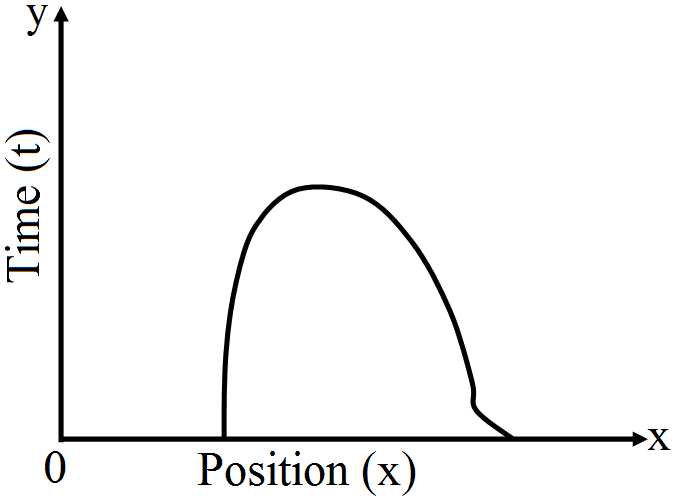
Is the time variation of position shown in figure observed in nature possible?

Suppose the amplitude of a simple pendulum having a bob of mass m is $\theta_0.$ Find the tension in the string when the bob is at its extreme position.
Which of the following functions of time represent (a) simple harmonic, (b) periodic but not simple harmonic, and (c) non-periodic motion? Give period for each case of periodic motion ($\omega$ is any positive constant):

$\cos\omega\text{t}+\cos3\omega\text{t}+\cos5\omega\text{t}$