Question
How is the value of spring constant affected when several small indentical spring are combined (i) in series and (ii) in parallel?

Answer

When we combine several small identical spring in series, then the value of the effective spring constant $k$ of the combination becomes $\frac{1}{n}$ times the each small spring.
Here $n$ is the number of small identical spring. That is, compared $\frac{1}{n}$ to spring connected in parallel, the effective force constant is equal to the sum of the force constant of each spring.
$
k=k_1+k_2
$

Need a full question paper?

Generate a complete, print-ready paper with questions like this in minutes — across 16+ boards, with answer keys.
Start Generating Free

Similar questions

Calculate the mass of 1cm3 of oxygen kept at STP.
In a Quincke's experiment the sound detected is changed from a maximum to a minimum when the sliding tube is moved through a distance of 2.50cm. Find the frequency of sound if the speed of sound in air is 340m/s.
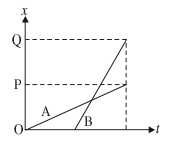
The position-time (x-t) graphs for two children A and B returning from their school O to their homes P and Q respectively are shown in Fig. Choose the correct entries in the brackets below :
(a) (A/B) lives closer to the school than (B/A)
(b) (A/B) starts from the school earlier than (B/A)
(c) (A/B) walks faster than (B/A)
(d) A and B reach home at the (same/different) time
(e) (A/B) overtakes (B/A) on the road (once/twice).
Image
The escape speed on the earth is 11.2km/ s.What is its value for a planet having double the radius and eight times the mass of the earth?
Explain the difference between weight and mass.
Two conducting spheres of radii R1 and R2 are kept widely separated from each other. What are their individual capacitances? If the spheres are connected by a metal wire, what will be the capacitance of the combination? Think in terms of series-parallel connections.
Magnitude of force F experienced by a certain object moving with speed v is given by F = Kv2 where K is a constant. Find the dimensions of K.
By hanging a mass of 0.60 kg from a spring, its length increases by 0.25 m , if a mass of 0.24 kg is hung in a spring and left a little below, then what will be the time period of the spring? $\left(g=10 m / s ^2\right)$
Considering a household refrigerator as a reversible engine operating between the melting point of ice and room temperature $27^{\circ} C$, estimate the energy provided joules ( $J$ ) to freeze 1 kg of water, the temperature of water is given in $0^{\circ} C , L = 8 0 Cal g ^{-1}$.
A body constrained to move along the z-axis of a coordinate system is subject to a constant force F given by $\text{F}=-\hat{\text{i}}+2\hat{\text{j}}+3\hat{\text{k}}\text{N}$ where $\hat{\text{i}},\hat{\text{j}},\hat{\text{k}}$ are unit vectors along the x, y and z-axis of the system respectively. What is the work done by this force in moving the body a distance of 4m along the z-axis?