MCQ
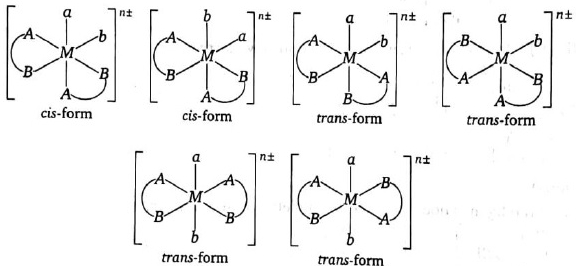
How many geometrical isomers are possible for complex $[Mab(AB)_2]^{±n}$
  • A
    $5$
  • B
    $4$
  • C
    $3$
  • $6$

Answer

Correct option: D.
$6$
d
six geometrical isomers are possible for complex $\left[\mathrm{Mab}(\mathrm{AB})_{2}\right]^{\mathrm{n} \pm}$

Need a full question paper?

Generate a complete, print-ready paper with questions like this in minutes — across 16+ boards, with answer keys.
Start Generating Free

Similar questions

Rank the following compounds in decreasing order of reactivity Electrophilic Aromatic substitution reaction
Which of the following compound on ozonolysis give a compound that give silver mirror with tollen's reagent ?
In the given reaction :

$C{H_3}CHO\mathop {\xrightarrow{{(i)\,NaCN/HCl}}}\limits_{(ii)\,{H_2}O/{H^ \oplus }/\Delta } (A)\mathop {\xrightarrow{{Fenton}}}\limits_{reagent} (B)$

$(B)$ will be :

Among the electrolytes $\mathrm{Na}_2 \mathrm{SO}_4, \mathrm{CaCl}_2, \mathrm{Al}_2\left(\mathrm{SO}_4\right)_3$ and $\mathrm{NH}_4 \mathrm{Cl}$, the most effective coagulating agent for $\mathrm{Sb}_2 \mathrm{~S}_3$ sol is
$\begin{array}{*{20}{c}}
  {C{H_3} - CH - CH = C{H_2} + HBr \to X(product)} \\ 
  {|\,\,\,\,\,\,\,\,\,\,\,\,\,\,\,\,\,\,\,\,\,\,\,\,\,\,\,\,\,\,\,\,\,\,\,\,\,\,\,\,\,\,\,\,\,\,\,\,\,\,\,\,\,\,\,\,\,\,\,\,\,\,\,\,\,\,\,\,\,\,\,\,\,\,\,\,} \\ 
  {C{H_{3\,\,\,\,\,\,\,\,\,\,\,}}\,\,\,\,\,\,\,\,\,\,\,\,\,\,\,\,\,\,\,\,\,\,\,\,\,\,\,\,\,\,\,\,\,\,\,\,\,\,\,\,\,\,\,\,\,\,\,\,\,\,\,\,\,\,\,\,\,\,\,\,\,\,\,} 
\end{array}$

What is the major product i.e. $X$ in the reaction?

For a dilute solution, Raoult's law states that
At a given temperature, the equilibrium constant for reaction $PC{l_5}_{(g)}$ $\rightleftharpoons$ $PC{l_3}_{(g)} + C{l_2}_{(g)}$ is $2.4 \times {10^{ - 3}}$. At the same temperature, the equilibrium constant for reaction $PC{l_3}_{(g)} + C{l_2}_{(g)}$ $\rightleftharpoons$ $PC{l_5}_{(g)}$ is
Which is the correct order of increasing energy of the listed orbitals in the atom of titanium? (At. no. $Z = 22$)
In qualitative analysis, the metals of group $I$ can be separated from other ions by precipitating them as chloride salts. A solution initially contains $Ag^+$ and $Pb^{2+}$ at a concentration of $0.10 \,M.$  Aqueous $HCl$ is added to this solution until the $Cl^-$ concentration is $0.10\, M.$What will the concentrations of $Ag^+$ and $Pb^{2+}$ be at equilibrium ? ($K_{sp}$ for $AgCl = 1.8 \times 10^{-10},$$ K_{sp}$ for $PbCl_2 = 1.7 \times 10^{-5}$)
$2\, Mn O _{4}^{-}+ b\, C _{2} O _{4}^{2-}+ c\, H ^{+} \rightarrow x\, Mn ^{2+}+ y\, CO _{2}$ $+ z\, H _{2} O$

If the above equation is balanced with integer coefficients, the value of $c$ is ...........

(Round off to the Nearest Integer).