MCQ
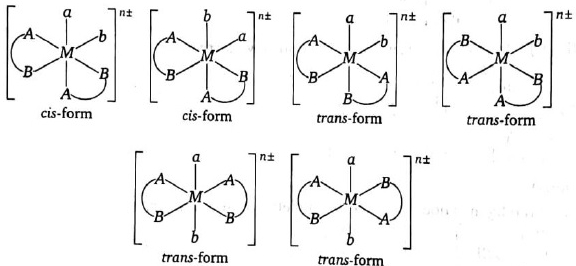
How many geometrical isomers are possible for complex $[Mab(AB)_2]^{±n}$
  • A
    $5$
  • B
    $4$
  • C
    $3$
  • $6$

Answer

Correct option: D.
$6$
d
six geometrical isomers are possible for complex $\left[\mathrm{Mab}(\mathrm{AB})_{2}\right]^{\mathrm{n} \pm}$

Need a full question paper?

Generate a complete, print-ready paper with questions like this in minutes — across 16+ boards, with answer keys.

Start Generating Free

Similar questions

Which one of the following is an inner orbital complex as well as diamagnetic in behaviour (Atomic number : $Zn = 30$, $Cr = 24$, $Co = 27$, $Ni = 28$)
For the reaction $N_2(g) + 3H_2(g) \to  2NH_3(g)$ under certain conditions of temperature and partial pressure of the reactants, the rate of formation of $NH_3$ is $0.001\, kg\, lit^{-1}\, h^{-1}$. The rate of conversion of $H_2$ under the same condition is ..... $kg\, lit^{-1}\, h^{-1}$.
The correct order of the number of unpaired electrons in the given complexes is

$A.$ $\left[ Fe ( CN )_6\right]^{3-}$;$B.$ $\left[ FeF _6\right]^{3-}$; $C.$ $\left[ CoF _6\right]^{3-}$; $D.$ $\left[ Cr (\text { oxalate })_3\right]^{3-}$; $E.$ $\left[ Ni ( CO )_4\right]$

Choose the correct answer from the options given below:

Given below are two statements, one is labelled as Assertion $A$ and the other is labelled as Reason $R$.

Assertion $A$ : $\left[ CoCl \left( NH _3\right)_5\right]^{2+}$ absorbs at lower wavelength of light with respect to $\left[ Co \left( NH _3\right)_5\left( H _2 O \right)\right]^{3+}$

Reason $R$ : It is because the wavelength of the light absorbed depends on the oxidation state of the metal ion.

In the light of the above statements, choose the correct answer from the options given below :

Match the compounds/ions in Column $I$ with their properties/reactions in Column $II$. Indicate your answer by darkening the appropriate bubbles of the $4 \times 4$ matrix given in the $ORS$.
Column $I$ Column $II$
$(A)$ $\mathrm{C}_6 \mathrm{H}_5 \mathrm{CHO}$ $(p)$ gives precipitate with $2, 4$-dinitrophenylhydrazine
$(B)$ $\mathrm{CH}_3 \mathrm{C} \equiv \mathrm{CH}$ $(q)$ gives precipitate with $\mathrm{AgNO}_3$
$(C)$ $\mathrm{CN}^{-}$ $(r)$ is a nucleophile
$(D)$ $\mathrm{I}^{-}$ $(s)$ is involved in cyanohydrin formation
In a particular isomer of $[Co(NH_3)4Cl_2]^0,$ the $Cl - Co - Cl$ angle is $90^o ,$ the isomer is known as
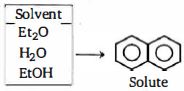
Rank the following solvents in decreasing order of ability to dissolve given compound.
Salicylaldehyde can be prepared from
When $CuS{O_4}$ is hydrated, then it becomes
$\mathrm{CuSO}_4$ decolourises on addition of $\mathrm{KCN}$, the product is