MCQ
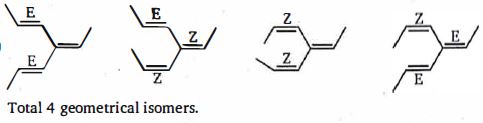
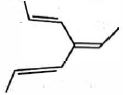
How many geometrical isomers are possible for the above compound ?
  • A
    $3$
  • $4$
  • C
    $6$
  • D
    $8$

Answer

Correct option: B.
$4$
b

Need a full question paper?

Generate a complete, print-ready paper with questions like this in minutes — across 16+ boards, with answer keys.

Start Generating Free

Similar questions

Starting from propanoic acid the following reactions were carried out as following $CH_3 - CH_2 - COOH$ $\xrightarrow{{SOC{l_2}}}\left[ X \right]\xrightarrow[\Delta ]{{N{H_3}}}\left[ Y \right]\xrightarrow[{KOH}]{{B{r_2}}}\left[ Z \right]$ Product $[Z]$ will be?
Appropriate reducing agent for the following conversion is-

$\begin{array}{*{20}{c}}
  {\,\,\,\,\,\,\,\,\,\,\,\,\,\,\,\,\,\,\,\,\,\,\,\,\,\,\,\,\,\,\,\,\,\,\,\,\,\,\,\,\,\,\,O} \\ 
  {\,\,\,\,\,\,\,\,\,\,\,\,\,\,\,\,\,\,\,\,\,\,\,\,\,\,\,\,\,\,\,\,\,\,\,\,\,\,\,\,\,\,\,||} \\ 
  {C{H_2} = CH - C{H_2} - C - H} 
\end{array} \to C{H_3} - C{H_2} - C{H_2} - C{H_2}OH$

Given 

$(I)$ ${H_2}(g) + \frac{1}{2}{O_2}(g) \to {H_2}O(l);$

$\Delta {H^o_{298\,K}} =  - 285.9\,kJ\,mo{l^{ - 1}}$

$(II)$ ${H_2}(g) + \frac{1}{2}{O_2}(g) \to {H_2}O(g);$

$\Delta {H^o_{298\,K}} =  - 241.8\,kJ\,mo{l^{ - 1}}$

The molar enthalpy of vapourisation of water will be.....$kJ\,mol^{-1}$

The rates of a certain reaction $(dc/dt)$ at different times are as follows

Time                                 Rate (mole $litre^{-1}\,sec^{ -1}$ )

$0$                                        $2.8 \times {10^{ - 2}}$

$10$                                      $2.78 \times {10^{ - 2}}$

$20 $                                     $2.81 \times {10^{ - 2}}$

$30$                                       $2.79 \times {10^{ - 2}}$

The reaction is
Which of the following atom or ions has the smallest size?
Which element gives maximum balanced oxide
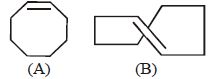
Relation between $(A)$ and $(B)$ is
Three substances $A, B$ and $C$ can react to form $E$ and $D$ as shown $2A + 3B + C \rightarrow  4D + 2E$  If molar masses of  $A,B,C$ and $D$ are $40, 30, 20$ and $15$ respectively and $570\  gm$ of mixture of $A, B$ & $C$ is reacted then maximum mass of $E$ which can be obtained will be ............ $\mathrm{gm}$
Which one is strongest electrolyte in the following
Calcium carbide + heavy water $ \to$ ?
The product of the above reaction is