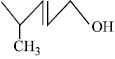
MCQ
How many geometrical isomers are possible for the above compound ?

- A$0$
- ✓$2$
- C$3$
- D$4$
Generate a complete, print-ready paper with questions like this in minutes — across 16+ boards, with answer keys.
$(A)\, F^-, Na^+, Mg^{+2}$ $(B) \,Ni, Cu, Zn$
$(C)\, N^{-3}, Cs^+, H^-$ $(D)\, Li, He, Be^{+2}$
$\Delta\text{S}(\text{C}\rightarrow\text{D})=30\text{ev},$
$\Delta\text{S}(\text{B}\rightarrow\text{D})=20\text{ev}$
$\text{A}\rightarrow\text{B}\\\downarrow\ \ \ \ \ \uparrow\\\text{C}\rightarrow\text{D}$
The entropy change for A → B would be:
$C{O_{\left( g \right)}} + \frac{1}{2}{O_{2\left( g \right)}} \to C{O_{2\left( g \right)}}\,;\,\Delta H = - 300\,kJ$
${H_2}_{\left( g \right)} + \frac{1}{2}{O_2}_{\left( g \right)} \to {H_2}{O_{\left( g \right)}}\,;\,\Delta H = - 250\,kJ$
$C_{(s)} + O_{2(g)} \to CO_{2(g)} ; \Delta H = -x\, kJ$
The value of $x$ will be
Statement $(I)$ : Both metal and non-metal exist in $\mathrm{p}$ and $d$-block elements.
Statement $(II)$ : Non-metals have higher ionisation enthalpy and higher electronegativity than the metals.
In the light of the above statements, choose the most appropriate answer from the option given below: