MCQ
How many gm of bromine will react with $21\, gm$ ${C_3}{H_6}$
  • $80$
  • B
    $160$
  • C
    $240$
  • D
    $320$

Answer

Correct option: A.
$80$
a
(a) $\mathop {\mathop {\mathop {C{H_3} - CH}\limits_{{\rm{Propane}}} }\limits_{{\rm{1 \,mole}}} }\limits_{{\rm{42 }}\,gms} = \,\,C{H_2}\,\, + \mathop {B{r_2}}\limits_{\mathop {1\,{\rm{mole}}}\limits_{42\,{\rm{ }}gms} } \to C{H_3} - \mathop {\mathop {\mathop {C{H_2}}\limits_{|\,\,\,\,\,\,\,\,} }\limits_{Br\,\,\,\,} - \mathop {\mathop {C{H_2}}\limits_{|\,\,\,\,\,\,\,\,} }\limits_{Br\,\,\,\,} }\limits_{{\rm{1, 2 - dibromo propane}}} $

$42\, gm$ of propene reacts with $160\, gms$ of bromine.

$\therefore $ $21\,gms$ of propene $\frac{{160}}{{42}} \times \,21 = 80\,gms$.

Need a full question paper?

Generate a complete, print-ready paper with questions like this in minutes — across 16+ boards, with answer keys.

Start Generating Free

Similar questions

If the concentration of lead iodide in its saturated solution at ${25\,^o}C$ be $2 \times {10^{ - 3}}$ moles per litre, then its solubility product is
Number of molecules from below which cannot give ioddoform reaction is :
Ethanol, Isopropyl alcohol, Bromoacetone, 2-Butanol, 2-Butanone, Butanal, 2-Pentanone, 3-Pentanone, Pentanal and 3-Pentanol
In the above chemical reaction sequence " $\mathrm{A}$ " and " $\mathrm{B}$ " respectively are :
Which of the set of species have same hybridisation state but different shapes
Which of the following undergoes reduction (By $H_2|Ni$ ) at fastest rate
The pair of the compounds in which both the metals are in the highest possible oxidation state is
Following eclipsed form of propane is repeated after rotation by an angle of......$^o$
At $298 K$, the limiting molar conductivity of a weak monobasic acid is $4 \times 10^2 S cm ^2 mol ^{-1}$. At $298 K$, for an aqueous solution of the acid the degree of dissociation of $\alpha$ and the molar conductivity is $y \times 10^2 S cm ^2 mol ^{-1}$. At $298 K$, upon $20$ times dilution with water, the molar conductivity of the solution becomes $3 y \times 10^2 S cm ^2 mol ^{-1}$.

($1$) The value of $\alpha$ is. . . . . . 

($2$) The value of $y$ is. . . . . . .

Give the answer or quetion ($1$) and ($2$)
The compound $X\, (C_5H_8)$ reacts with ammonical $AgNO_3$ to give a white precipitate and reacts with excess of $KMnO_4$ to give the acid, $(CH_3)_2CH-COOH$, therefore $X$ is
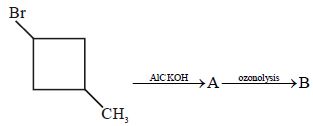
Identify the final product $(B)$.