Question
How many images will be formed when an object is placed between two parallel plane mirrors with their reflecting surfaces facing each other? Why do more distant images appear fainter?

Answer

Angle between two mirrors facing each other $=\theta=0^{\circ}$
No. of images formed $=n=\frac{360^{\circ}}{\theta}=\frac{360^{\circ}}{0}=\infty$
So, infinite number of images are formed when an object is placed between two parallel plane mirrors with their reflecting surfaces facing each other.
More distant images appear fainter when two plane mirror with their reflecting surfaces facing each other because,
After every successive reflection, some amount of light energy is absorbed. Thus luminosity of images goes on decreasing and hence they appear fainter.

Need a full question paper?

Generate a complete, print-ready paper with questions like this in minutes — across 16+ boards, with answer keys.
Start Generating Free

Similar questions

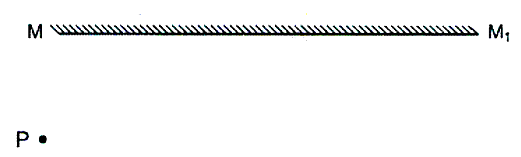
The diagram in Figure shows a point object P in front of a plane mirror$ MM_1.$

(a) Complete the diagram by taking two rays from the point P to show the formation of its image.

(b) In the diagram, mark the position of eye to see the image.

(c) Is the image formed real or virtual? Explain why?
What do you mean by zero error of a screw gauge? How is it accounted for?
(a) What is a second's pendulum?
(b) A second's pendulum is taken on the surface of moon where acceleration due to gravity is $l / 6$ th of that of earth. Will the time period of pendulum remain same or increase or decrease? Give a reason.
A solid weighs 2.10 N in air. It has a relative density of 8.4. How much will the body weigh if placed: In a liquid of relative density 1.2
It takes 0.2 s for a pendulum bob to move from the mean position to one end. What is the time period of the pendulum?
Draw a ray diagram to show the formation of image by a concave mirror for the object beyond its centre of curvature. State three characteristics of the image.
The frequency of a source of sound is 100 Hz. How many times does it vibrate in a minute?
A car is moving with a velocity $20 m s^{-1}.$ The brakes are applied to retard it at a rate of $2 m s^{-2}.$ What will be the velocity after $5 s$ of applying the brakes?
State the law which governs the energy flow in an ecosystem.
An object 5 cm high is placed at a distance 60 cm in front of a concave mirror of focal length 10 cm. Find the position and size of the image.