MCQ
How many ions are produced in aqueous solution of $[Co{({H_2}O)_6}]\,C{l_2}$
  • A
    $2$ 
  • $3$ 
  • C
    $4$ 
  • D
    $6$ 

Answer

Correct option: B.
$3$ 
b
(b)$[Co\,{({H_2}O)_6}]\,C{l_2}$ $ \rightleftharpoons $ ${[Co\,{({H_2}O)_6}]^ + } + 2C{l^ - }$.

Need a full question paper?

Generate a complete, print-ready paper with questions like this in minutes — across 16+ boards, with answer keys.

Start Generating Free

Similar questions

In the following sequence of reactions, the alkene affords the compound  $'B'$

$CH_3 - CH = CH - CH_3 \xrightarrow{{{O_3}}} A $$\xrightarrow[{Zn}]{{{H_2}O}} B.$

The compound $B$ is

The rate constant for a first order reaction at $300\,^oC$ for which $E_a$ is $35\, K\,Cal\,mol^{-1}$ and frequency constant is $1.45\times 10^{11}s^{-1}$ will be
Number of optical isomers in the open chain structure of glucose is
Consider the following first order gas phase reaction at constant temperature

$\mathrm{A}(\mathrm{g}) \rightarrow 2 \mathrm{~B}(\mathrm{~g})+\mathrm{C}(\mathrm{g})$

If the total pressure of the gases is found to be $200$ torr after $23 \mathrm{sec}$. and $300$ torr upon the complete decomposition of $\mathrm{A}$ after a very long time, then the rate constant of the given reaction is . . . . . .$\times 10^{-2} \mathrm{~s}^{-1}$ (nearest integer)

[Given : $\log _{10}(2)=0.301$ ]

$IUPAC$ name of the given compound is ?
$(CH_3)_3CCH=CHC_6H_4Br-p$
The bond in the formation of fluorine molecule will be
The mass of sodium acetate $\left(\mathrm{CH}_3 \mathrm{COONa}\right)$ required to prepare $250 \mathrm{~mL}$ of $0.35\  \mathrm{M}$ aqueous solution is ____$g$. (Molar mass of $\mathrm{CH}_3 \mathrm{COONa}$ is $82.02 \mathrm{~g} \mathrm{~mol}^{-1}$ )
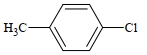
The $IUPAC$ name(s) of the following compound is(are)

$[A]$ $4$-methylchlorobenzene   $[B]$ $4$-chlorotoluene   $[C]$ $1$-chloro-$4$-methylbenzene    $[D]$ $1$-methyl-$4$-chlorobenzene
A litre of solution is saturated with $AgCl$. To this solution if $1.0 \times {10^{ - 4}}$ mole of solid $NaCl$ is added, what will be the $[A{g^ + }]$, assuming no volume change
Which of the following molecules has one lone pair of electrons on the central atom