Question
How many levels are there in external environment? Explain.

Answer

The external environment consists of two levels, i.e. micro environment and macro environment.
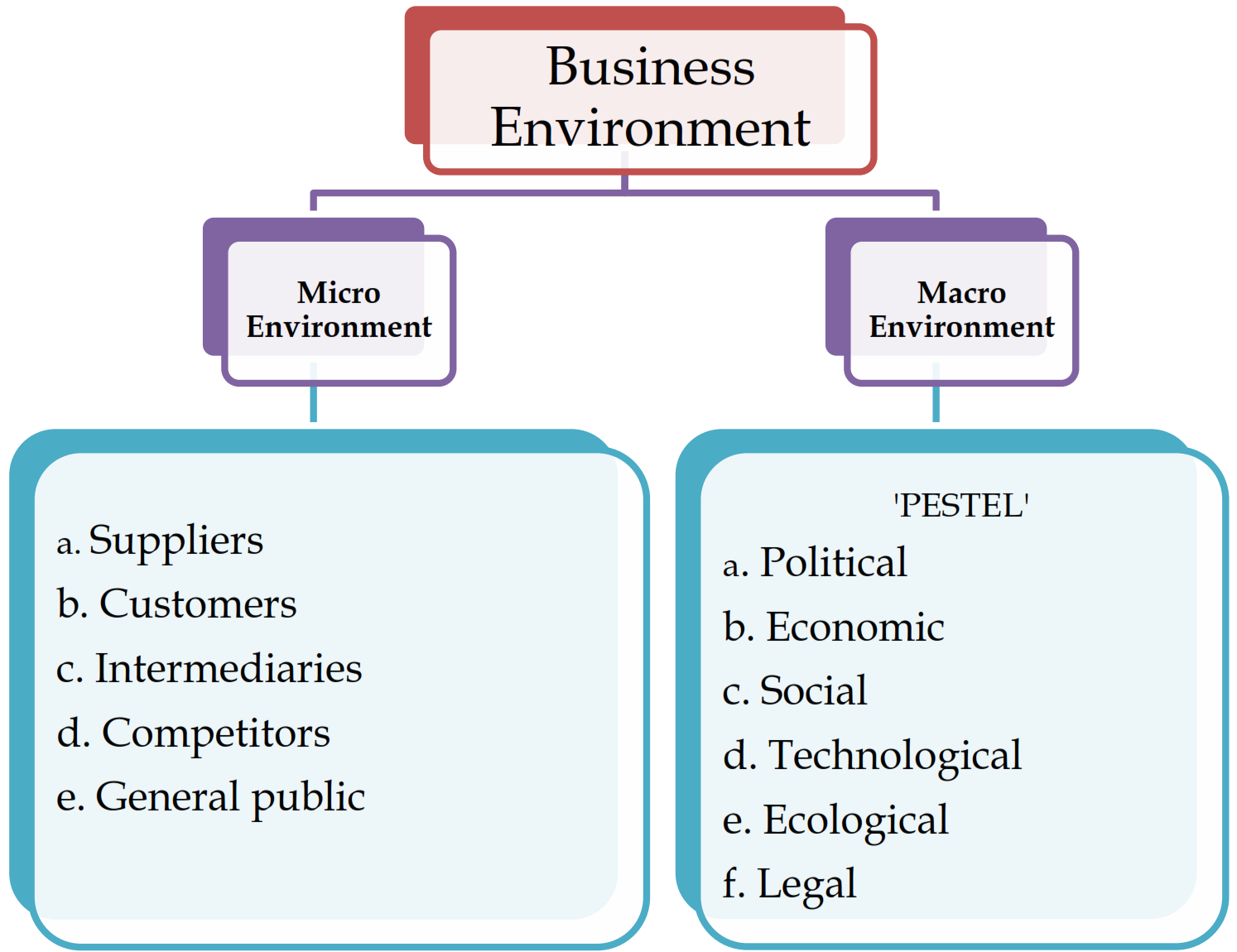
Producer/ Seller: The goals, objectives, policies, strategies, etc. of the organization are the foremost forces which govern the market. Successful companies are those that can recognize and respond profitably to unmet needs and trends in the society.
Customers: Consumer satisfaction is the foundation stone of a successful business. Business has to produce goods according to the needs,taste and preferences of the customers. Enterprises have to take into consideration the following features to create, maintain and retain this force Tradition, customs, beliefs, values of society, lifestyle. standard of living, consuming, habit, thinking behaviour, income level, demographic characteristics, etc.
Competitors: Competitors are such factors in the micro environment that provide similar offerings for goods and services. To remain competitive, an enterprise must consider who their biggest competitors are.
Suppliers: Suppliers are another key component in the core system of market. Any manufacturing unit uses necessary resources for the conversion of input (material, machines labour and funds) into output for that the necessary resources are generally obtained by the supplier.
The companies growth depends upon the production and production depends upon the regular supply of resources therefore working of the various supply markets depends upon maintaining good relations with suppliers. Lack or non-availability of suppliers can ruin the market for a product.
Marketing Intermediaries: Marketing intermediaries are institutions that facilitate the flow of goods and services between the company and its final markets. They include resellers (i.e. wholesalers, retailers, agents, and brokers), transporters, warehouses, banks and promoting agencies.
These all institutions come into being to facilitate the work of consummating exchanges in the market. They perform a great deal of work in bringing about transactions between the buyers and sellers, market cannot survive without these intermediaries.
Macro Environment includes: Political factor: Political factors is the outcome of a combination of various ideologies advocated by different political parties. The rules and regulations and the laws that monitor and regulate the market forces are framed and promulgated by the government. This include the political factor. These policies generated aims at improving infrastructural facilities which encourage new business ventures.
For example, after relaxation of import export policies, an entrepreneur who exported textile material used its earning to import heavy industrial machines.
Economic factor: It includes the close study of important variables like supply and demand. Details of consumer trends, economic preference, costing, discounting, etc. are all economic decisions. Economic details will also help the entrepreneur in determining the size of the project and the reasons of finance.
Socio-Cultural factor: Business is born and develops in society and in it various social factors exists. It involves a close study of the life styles, beliefs, customs, conventions, practices, etc. Expectations of individuals their preferences on the basis of their family background, age group and education will also form a part of this study. The main aim of an entrepreneur is to satisfy the need of all individuals of a society.
For example, an entrepreneur wants to open a showroom of branded footwears. Hence, he will target the high income group of society.
Technological factors: It is influenced by government spending on research, new discoveries and development, government and industry focus of technological effort, speed of technological transfer and rates of obsolescence.
Ecological factors: It considers the ways in which the organisation can produce its goods or services with minimum environmental damage.
Legal and finance factors: Legal scanning of the environment demands analyzing the legal requirements in the establishment of a project. Managing of the project and also in getting assistance from different sources. For example, welfare of employees, safety, simple contracts entered into with suppliers of raw materials financer's, real estate owners, etc. require legal assistance.

Need a full question paper?

Generate a complete, print-ready paper with questions like this in minutes — across 16+ boards, with answer keys.

Start Generating Free

Similar questions

A hotel had varying number of guests during five weeks. The information regarding the number of guests and the average weekly billing is presented in the following table:
Week
No. of Guests
Average Billed Amount
1
240
300
2
120
410
3
140
292
4
160
442
5
180
480
  1. What is the ‘Unit of Sale’ and ‘Unit Price’ in this case?
  2. If the cost of goods sold or variable cost is 60% of the sales price, calculate the ‘unit cost’ and the ‘gross profit’.
Describe some examples of franchising by Indian firms.
What are the various ways in which an entrepreneur spots trends?
Naveen has just completed his B. Tech. And want to start his own business. He knew that the demand of electricity in India was increasing day by day, whereas its generation was not sufficient. Naveen shared his views with some of his friends, and they all decided to start the business of electricity generation. They experimented various methods and ultimately succeeded in electricity generation through garbage. They all were very happy as India is also facing the problem of garbage disposal.
Identify and explain the source of 'Idea-field’ from where the idea had been generated by Naveen and his friends.
Also, explain two other sources of Idea-fields with the help of example.
Describe any three fields of ideas, with suitable examples.
Rahil (Finance) and Anushk (HR) are doing MBA (IIM Indore). While reading the newspaper Anushk saw the heading 'Sensex goes up. But last week the heading was different that 'Sensex goes down.' Now some confusion was going on his mind, immediately he asked his friend Rahil the same. Now according to you, how Rahil will clear the confusion of Anushk? Explain and give some value points.
Sanora company produces and sells pottery chimneys (small clay outdoor fire places). The chimneys come in three models Small Basic, Large Basic and Carved (Ornately shaped and Carved). In the coming year Sanora sold 30,000 Small Basic Models, 50,000 Large Basic Models, and 20,000 Carved Models. Information on the three models is as follows:
 
Small Basic
Large Basic
Carved
Sales price per unit
₹ 120
₹ 200
₹ 350
Variable cost per unit
₹ 70
₹ 150
₹ 275
The total fixed expenses of the company are 456500.
From the following calculate:
  1. Sales Mix Ratio.
  2. Overall Break-Even Point.
  3. Product wise Break-Even Point (in Units).
Abhinay started a small scale industry where he produces 3 types of products Tomato Sauce, Cheese Spread and Mixed fruit jam sales for December were as follows:
Product
Cheese Spread
Tomato Sauce
Mixed Fruit Jam
Bottles sold
100
40
60
Average Unit Price
80
45
60
Average Unit cost
40
15
20
Fixed cost = 3420
From the given information you are required to calculate:
  1. Weighted average selling price
  2. Weighted average variable cost
  3. Overall break-even point
  4. Product wise break-even point
  5. Break-even point = Fixed Income = Contribution
Abhinav started a small scale industry where he produces 3 types of products i.e.; Tomato Sauce, Cheese Spread and Mixed fruit jam Sales for December, a multi product company.
Deepika is running a Beauty parlour and had varying number of customers during 5 weeks. This information and the average weekly billing amount are in the following table. From the given information:
Week
No. of Customers
Average amount billed(in ₹)
1
20
115
2
20
110
3
6
165
4
21
210
5
23
100
6
20
160
Calculate: Total Bill Amount, Unit of sale, Unit Price, Unit cost. If the cost of goods sold or variable cost is 60% of the sale price, Gross Margin - per Unit of Sale.
Jumbo Jee Company started a business of making three type of sauces Soya Sauce, White Sauce, Tomato Sauce. Fixed costs are 12,90,000 per year. Sales revenue and variable costs per unit are as follows:
 
Soya Sauce
White Sauce
Tomato Sauce
Sales Price (₹)
80
45
60
Variable Costs
40
15
15
Bottle
100
40
60
 
From the following information calculate :
  1. Prepare an income statement for calculating gross contribution margin for all product.
  2. Contribution margin per unit
  3. Contribution margin for 20 bottles
  4. Over all Break-even point
  5. Statement showing at break even, fixed expenses = contribution margin.