MCQ
How many linear equations are satisfied by x = 2 and y = -3?
  • A
    Only one.
  • B
    Two.
  • C
    Three.
  • D
    Infinitely many.

Answer

  1. Infinitely many.
    Solution:
    From Point (2, -3) there are infinitely many lines passing in every-direction.
    So (2, -3) is satisfied with infinite linear equations.
    Hence, correct option is (d).

Need a full question paper?

Generate a complete, print-ready paper with questions like this in minutes — across 16+ boards, with answer keys.
Start Generating Free

Similar questions

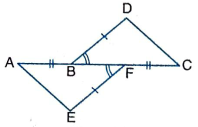
In Fig , if $A B=F C, E F=B D$ and $\angle A F E=\angle C B D$. Then, the rule by which $\triangle A F E \cong \triangle C B D$ is
Image
The bisectors of the angle of a parallelogram enclose a:
  1. Parallelogram.
  2. Rhombus.
  3. Rectangle.
  4. Square.
The mean of the below frequency distribution is 3.5, then the value of x is:
Varible
1
2
x
4
5
Frequency
2
3
4
5
6
Directions: In the following questions, the Assertions (A) and Reason(s) (R) have been put forward. Read both the statements carefully and choose the correct alternative from the following:
Assertion: The perimeter of a right angled triangle is 60cm and its hypotenuse is 26cm. The other sides of the triangle are 10cm and 24cm. Also, area of the triangle is 120cm2.
Reason: (Base)2 + (Perpendicular)2 = (Hypotenuse)2.
In a histogram the class intervals or the groups are taken along
Euclid stated that all right angles are equal to each other in the form of
$\frac{5^{\text{n}+2}-6\times5^{\text{n}+1}}{13\times5^\text{n}-2\times5^{\text{n}+1}}$ is equal to:
The class marks of a frequency distribution are given as follows 15, 20, 25 the class corresponding to the class mark 20 is:
A point whose abscissa and ordinate both are negative will lie in
The mid-points of the sides of a triangle ABC along with any of the vertices as the fourth point make a parallelogram of area equal to:
  1. $\text{ar}(\triangle\text{ABC})$
  2. $\frac{1}{2}\text{ar}(\triangle\text{ABC})$
  3. $\frac{1}{3}\text{ar}(\triangle\text{ABC})$
  4. $\frac{1}{4}\text{ar}(\triangle\text{ABC})$