Question
How many numbers are there between $101$ and $999$, which are divisible by both $2$ and $5$?

Answer

For the number to be divisible by both 2 and 5, they have to be divisible by the LCM of $2$ and $5 = 10$.
The numbers divisible by 10 between 101 and 999
Are $110, 120, 130, ...., 990$
Here
$a = 110$
$d = 10$
$a_n = a + (n - 1)d$
$\Rightarrow 990 = 110 + (n - 1)(10)$
$\Rightarrow 990 = 110 + 10n - 10$
$\Rightarrow 890 = 10n$
$\Rightarrow n = 89$
Thus, $89$ numbers between $101$ and $999$ are divisible by both $2$ and $5$.

Need a full question paper?

Generate a complete, print-ready paper with questions like this in minutes — across 16+ boards, with answer keys.
Start Generating Free

Similar questions

Show that A(-3, 2), B(-5, -5), C(2, -3), and D(4, 4) are the vertices of a rhombus.
7 audio cassettes and 3 video cassettes cost Rs. 1110, while 5 audio cassettes and 4 video cassettes cost Rs. 1350. Find the cost of an audio cassette and a video cassette.
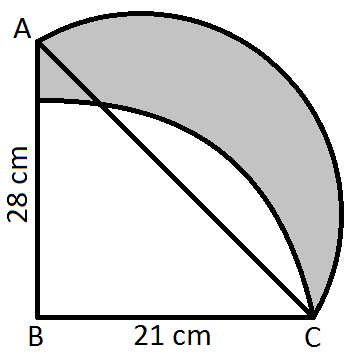
In the following figure, ABC is a right-angled triangle,$\angle\text{B}=90^\circ,$ $AB = 28\ cm$ and $BC = 21\ cm$.
With $AC$ as diameter a semicircle is drawn and with $BC$ as radius a quarter circle is drawn.
Find the area of the shaded region correct to two decimal places.
200 logs of wood are stacked in the following manner: 20 logs in the bottom row, 19 in the next row, 18 in the row next to it and so on. In how many rows 200 logs are placed and how many logs are there in the top row?
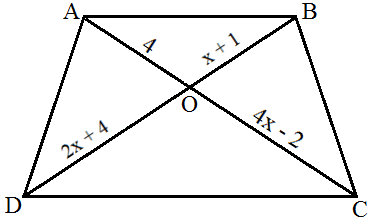
In the given figure, if $AB || CD,$ find the value of $x.$
Each coefficient in equation $a x^2+b x+c=0$ is obtained by throwing an ordinary die. Find the probability that the equation has real roots.
Find the value of x for which the numbers (5x + 2), (4x - 1) and (x + 2) are in AP.
∆ ABC is an equilateral triangle. Point P is on base BC such that  $PC = \frac{1}{3}BC$, if AB = 6 cm find AP.
If $10$ times the $10^{\text {th }}$ term of an A.P. is equal to $15$ times the $15^{\text {th }}$ term, show that $25^{\text {th }}$ term of the A.P. is zero.
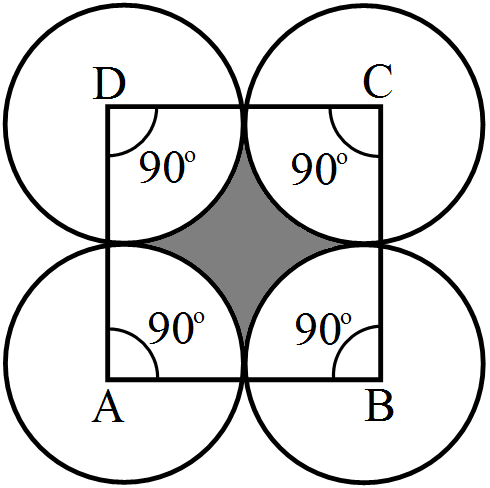
Four equal circles are described about the four corners of a square so that each touches two of the others, as shown in the figure. find the area of the shaded region, if each side of the square measures $14\ cm$.
$\Big[\text{Use }\pi=\frac{22}{7}\Big]$