MCQ
How many optically active (Lactide) product $(s)$ are formed in given reaction ?

$\begin{array}{*{20}{c}}
  {OH\,\,\,\,\,\,\,\,\,\,\,\,\,\,\,} \\ 
  {|\,\,\,\,\,\,\,\,\,\,\,\,\,\,\,\,\,\,\,} \\ 
  {C{H_3} - CH - COOH\xrightarrow{\Delta }} 
\end{array}$

  • A
    $2$
  • B
    $4$
  • $3$
  • D
    $1$

Answer

Correct option: C.
$3$
c
When lactic acid heated, $\alpha $ cyclic diester derivatives are formed called lactides. So, it exists in total $3$ isomers.

Need a full question paper?

Generate a complete, print-ready paper with questions like this in minutes — across 16+ boards, with answer keys.

Start Generating Free

Similar questions

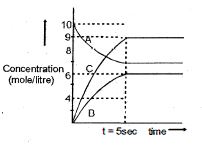
Attainment of the equilibrium $A(g) \rightleftharpoons 3C(g) + 2B(g)$ gave the following graph. Find the correct option. ($\%$ dissociation = fraction dissociated $\times \ 100$)
$\left( 1 \right)\,{N_2}\left( g \right) + 3{H_2}\left( g \right) \rightleftharpoons 2N{H_3}\left( g \right)\,,\,{K_1}$

$\left( 2 \right)\,{N_2}\left( g \right) + {O_2}\left( g \right) \rightleftharpoons 2NO\left( g \right)\,,\,{K_2}$

$\left( 3 \right)\,{H_2}\left( g \right) + \frac{1}{2}{O_2}\left( g \right) \rightleftharpoons {H_2}O\left( g \right)\,,\,{K_3}$

The equation for the equilibrium constart of the reaction

$2N{H_3}\left( g \right) + \frac{5}{2}{O_2}\left( g \right) \rightleftharpoons 2NO\left( g \right) + 3{H_2}O\left( g \right)$

$(K_4)$ in terms of $K_1 , K_2$ , and $K_3$ is

 True structure is predicted by:
Which of the following property of an element never changes?
Two mole of $HBr$ is added with $CH_3 -C$ $ \equiv $ $CH$ in presence of peroxide to give
The heat content of a system is called
The process in which higher hydrocarbons are broken down into lower hydrocarbons by controlled pyrolysis, is called
In which of the following pairs, both the species have the same hybridisation ?
$(I)\, SF_4 ,XeF_4\,\,\, (II)\, I^-_3,XeF_2\,\,\, (Ill)\, ICl^+_4 , SiCl_4\,\,\,(IV)\, ClO^-_3,PO^{3-}_4$
Predict the nature of $P$ in the following reaction

$C{H_3}C \equiv \,CC{H_3}\,\xrightarrow[{{\text{heat}}}]{{NaN{H_2}/{\text{inert solvent}}}}P$

Choose the correct answer. A thermodynamic state function is a quantity: