MCQ
How many organic products will be formed when the following compound undergoes decarboxylation?
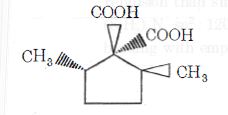
- A$0$
- B$1$
- ✓$2$
- D$3$
Generate a complete, print-ready paper with questions like this in minutes — across 16+ boards, with answer keys.
| Rate constant | Activation energy | |
| Step $1$ | $k_1$ | $E_{a_1} = 180\,kJ /mol$ |
| Step $2$ | $k_2$ | $E_{a_2} = 80\,kJ /mol$ |
| Step $3$ | $k_3$ | $E_{a_3} = 50\,kJ /mol$ |
overall rate constant, $k = {\left( {\frac{{{k_1}{k_2}}}{{{k_3}}}} \right)^{2/3}}$ overall activation energy of the reaction will be ........ $kJ\,mol$
(image)
$[A]$ Attractive intermolecular interactions between $L-L$ in pure liquid $L$ and $M-M$ in pure liquid $M$ are stronger than those between $L-M$ when mixed in solution
$[B]$ The point $Z$ represents vapour pressure of pure liquid $M$ and Raoult's law is obeyed when $x_{L} \rightarrow 0$
$[C]$ The point $Z$ represents vapour pressure of pure liquid $L$ and Raoult's law is obeyed when $x_{\mathrm{L}} \rightarrow 1$
$[D]$ The point $Z$ represents vapour pressure of pure liquid $M$ and Raoult's law is obeyed from $x_{L}=0$ to $x_{L}=1$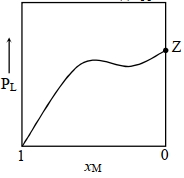
$\mathrm{H}_3 \mathrm{PO}_4 \ \ \ \ \mathrm{H}_2 \mathrm{SO}_4 \ \ \ \ \mathrm{H}_3 \mathrm{PO}_3 \ \ \ \ \mathrm{H}_2 \mathrm{CO}_3 \ \ \ \ \mathrm{H}_2 \mathrm{~S}_2 \mathrm{O}_7 $
$ \mathrm{H}_3 \mathrm{BO}_3 \ \ \ \ \mathrm{H}_3 \mathrm{PO}_2 \ \ \ \ \mathrm{H}_2 \mathrm{CrO}_4 \ \ \ \ \mathrm{H}_2 \mathrm{SO}_3 $