MCQ
How many protons are present in $1.8\,g \,NH_4^+$ ............. $N_A$
- A$1$
- B$1.2$
- ✓$1.1$
- D$11$
No. of $\mathrm{NH}_{4}^{+}$ ions in $1.8\, \mathrm{g}=\frac{1.8}{18} \times \mathrm{N}_{\mathrm{A}}=0.1\, \mathrm{N}_{\mathrm{A}}$
$\text { No. of protons in } 1.8\, \mathrm{g} \,\mathrm{NH}_{4}^{+} =11 \times 0.1\, \mathrm{N}_{\mathrm{A}}$
$=1.1 \,\mathrm{N}_{\mathrm{A}}$
Generate a complete, print-ready paper with questions like this in minutes — across 16+ boards, with answer keys.
| Compound | Weight $\%$ of $P$ | Weight $\%$ of $Q$ |
| $1$ | $50$ | $50$ |
| $2$ | $44.4$ | $55.6$ |
| $3$ | $40$ | $60$ |
$(A)$ If empirical formula of compound $3$ is $P_3 Q_4$, then the empirical formula of compound $2$ is $P_3 Q_5$.
$(B)$ If empirical formula of compound $3$ is $P _3 Q _2$ and atomic weight of element $P$ is $20$ , then the atomic weight of $Q$ is $45$ .
$(C)$ If empirical formula of compound $2$ is $PQ$, then the empirical formula of the compound $1$ is $P _5 Q _4$.
$(D)$ If atomic weight of $P$ and $Q$ are $70$ and $35$ , respectively, then the empirical formula of compound $1$ is $P _2 Q$.
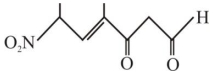
The major product $(B)$ is