MCQ
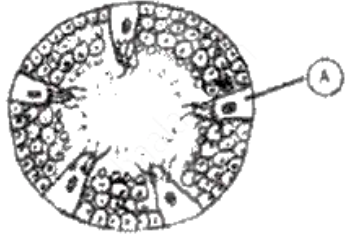
How many regions are there in a typical root?
  • Four
  • B
    Five
  • C
    Eight
  • D
    Six

Answer

Correct option: A.
Four
A

Need a full question paper?

Generate a complete, print-ready paper with questions like this in minutes — across 16+ boards, with answer keys.
Start Generating Free

Similar questions

From the following which reaction is decarboxylation reaction only?
The current flowing through moving coil galvanometer is 20% of the current to be measured. The resistance of moving coil galvanometer is 48 `Omega`, then shunt required is ____________.
Heat of combustion of $C_{(s)}, H_{2(g)}$_ and $C_2H_{6(g)} $ are $−x_1, −x_2 $ and $−x_3$ respectively. Hence heat of formation of $C_2H_{6(g)}​​​​​​​$ is $.........$
In the following diagram, what are A and its function?
Image
Number of electrons involved in the reaction, when $1$ Faraday of electricity is passed through an electrolytic solution is $..........$
Match the parts given in Column I with their physiological processes given in Column II.
Column I Column II
i. Proximal convoluted tubule a. Formation of concentrated urine
ii. Distal convoluted tubule b. Filtration of blood
iii. Henle's loop c. Reabsorption of 70-80% of electrolytes
iv. Vasa recta d. Ionic balance
v. Malpighian body e. Counter mechanism
Which of the following statements is TRUE for Wernicke's area?
Identify the process described in the following paragraph.

Repressible regulation of gene is seen when the end product of a biosyntbetic pathway like amino acid, is provided in the medium. At this time, internal biosynthesis of amino acid stops. It is negative control so the metabolite (amino acid) turns off a set of genes involved in producing that metabolite.

A ring of mass m and radius r rotates about an axis passing through its centre and perpendicular to its plane with angular velocity `omega`. Its kinetic energy is ______.
Which among the following oxides is amphoteric in nature?