MCQ
How many resistances are used in a Wheatstone bridge?
- A3
- B4
- C5
- D6
Explanation:
Wheatstone bridge is an arrangement of four resistors P, Q, R, and S, such that if we know the value of the resistances of any three of them, we can obtain the value of fourth unknown resistance. Therefore, there are 4 resistances in a Wheatstone bridge.
Generate a complete, print-ready paper with questions like this in minutes — across 16+ boards, with answer keys.
The back e.m.f. induced in a coil, when current changes from 1 ampere to zero in one milli‑second, is 4 volts, the self inductance of the coil is
|
(a) 1 H |
(b) 4 H |
(c) |
(d) 4 |
A transformer is employed to reduce 220 V to 11 V. The primary draws a current of 5 A and the secondary 90 A. The efficiency of the transformer is
|
(a) 20% |
(b) 40% |
(c) 70% |
(d) 90% |
How does the red shift confirms that the universe is expanding
|
(a) Due to Wien's law |
(b) Due to Stefan's law |
|
(c) Due to Kirchhoff's law |
(d) Due to Doppler's effect |
Two batteries of e.m.f. 4V and 8 V with internal resistances 1 W and 2 W are connected in a circuit with a resistance of 9 W as shown in figure. The current and potential difference between the points P and Q are

|
(a) |
(b) |
(c) |
(d) |
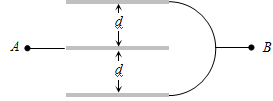
Three plates of common surface area A are connected as shown. The effective capacitance will be
|
(a) |
(b) |
(c) |
(d) |
Self induction of a solenoid is
|
(a) Directly proportional to current flowing through the coil |
|
(b) Directly proportional to its length |
|
(c) Directly proportional to area of cross-section |
|
(d) Inversely proportional to area of cross-section |


