MCQ
How many stereoisomers possible for
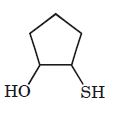
  • A
    $2$
  • B
    $3$
  • $4$
  • D
    $5$

Answer

Correct option: C.
$4$
c

Need a full question paper?

Generate a complete, print-ready paper with questions like this in minutes — across 16+ boards, with answer keys.
Start Generating Free

Similar questions

Which of the following pairs of compound are not isomers ?
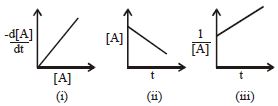
Consider the plots for the types of reaction. $nA \to  B + C$ These plots respectively corresponds to the reaction orders
$Be's$ $4^{th}$ electron will have four quantum numbers

            $n$                  $l$                 $m$                 $s$

An organic compound has $\%$ of $C$ and $\%$ of $H$ in the ratio $6 : 1$ and $\%$ of $C$ and $\%$ of $O$ in the ratio $3 : 4$. The compound is
Experimental evidence for the existence of the atomic nucleus comes from
Calculate $\Delta G^o (kJ/mol)$ at $127\,^oC$ for a reaction with $K_{equilibrium} = 10^5$
Total number of unpaired electrons in the complex ion $\left[\mathrm{Co}\left(\mathrm{NH}_3\right)_6\right]^{3+}$ and $\left[\mathrm{NiCl}_4\right]^{2-}$ is...............
Arrange the following compounds in order of increasing dipole moment.

(I) Toluene

(II) $m - $dichlorobenzene

(III) $o - $dichlorobenzene

(IV)$p - $dichlorobenzene

The neutralisation of a strong acid by a strong base liberates an amount of energy per mole of ${H^ + }$ that
Consider the following equations:

$2 Fe ^{2+}+ H _{2} O _{2} \rightarrow x A + y B$

(in basic medium)

$2 MnO _{4}^{-}+6 H ^{+}+5 H _{2} O _{2} \rightarrow x ^{\prime} C + y ^{\prime} D + z ^{\prime} E$

(in acidic medium)

The sum of the stoichiometric coefficients $x , y , x ^{\prime}, y ^{\prime}$ and $z ^{\prime}$ for products $A , B , C , D$ and $E ,$ respectively, is............