MCQ
How many structural isomers are possible for a compound with molecular formula ${C_3}{H_7}Cl$
  • $2$
  • B
    $5$
  • C
    $7$
  • D
    $9$

Answer

Correct option: A.
$2$
(a) Two isomers $C{H_3} - \mathop {\mathop {CH}\limits_{|\,\,\,\,} }\limits_{Cl} - C{H_3}$ and
$C{H_3} - C{H_2} - C{H_2}Cl$ are possible for ${C_3}{H_7}Cl$.
 

Need a full question paper?

Generate a complete, print-ready paper with questions like this in minutes — across 16+ boards, with answer keys.
Start Generating Free

Similar questions

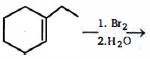
Choose the correct product of this reaction
The energies of activation for forward and reverse reactions for ${A_2} + {B_2} \rightleftharpoons 2AB$ are $180\, kJ\, mol^{-1}$ and $200\, kJ\, mol^{-1}$ respectively. The presence of a catalyst lowers the activation energy of both (forward and reverse) reactions by $100\, kJ\, mol^{-1}$. The enthalpy change of the reaction $(A_2 + B_2 \to  2AB)$ in the presence of catalyst will be (in $kJ\, mol^{-1}$)
The minimum energy a molecule should possess in order to enter into a fruitful collision is known as
At $345\, K$, the half life for the decomposition of a sample of a gaseous compound initially at $55.5\, kPa$ was $340\, s$. When the pressure was $27.8 \,kPa$, the half life was fund to be $170\, s$. The order of the reaction is $......$ [integer answer]
Choose the $CORRECT$ reason for fluorine being a stronger oxidising agent than chlorine 

$(I)$ Low enthalpy of dissociation of $F-F$ bond

$(II)$ High hydration enthalpy of $F^-$

$(III)$ Low atomisation enthalpy of $F_2$
The molar conductivities $\Lambda _{NaOH}^o$ and $\Lambda _{HCl}^o$ at infinite dilution in water at $25^o C$ are $91.0$ and $426.2\, S \,cm^2/mol$ respectively. To calculate $\Lambda _{HOAc}^o,$ the additional value required is
Which of the following has highest percentage of hydrogen
When vapours of an alcohol are passed over hot reduced copper, alcohol is converted into alkene quickly, the alcohol is
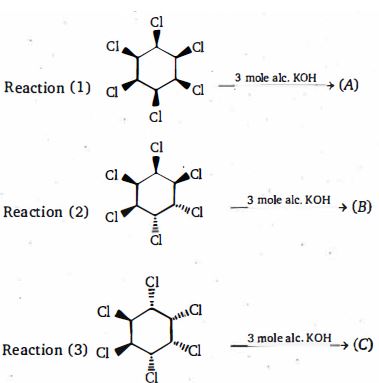
Product obtained in above reactions $(1), (2)$ & $(3)$ is
On the basis of the thermochemical equations
$H_2O(g) + C(s) \to CO(g) + H_2(g) \,\,\,\Delta H = 131\,kJ$
$CO(g) + \frac {1}{2} O_2(g) \to CO_2(g) \,\,\,\Delta H = –282\,kJ$
$H_2(g) + \frac {1}{2} O_2(g) \to H_2O(g) \,\,\,\Delta H = –242\,kJ$
$C(s) + O_2(g) \to CO_2(g) \,\,\,\Delta H = X\,kJ$
The value of $X$ will be....$kJ$