MCQ
How many structures of $F$ is possible
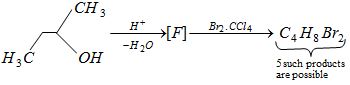
  • $2$
  • B
    $1$
  • C
    $6$
  • D
    $3$

Answer

Correct option: A.
$2$
a
$2$

$1$-Butene

$2$-Butene

Need a full question paper?

Generate a complete, print-ready paper with questions like this in minutes — across 16+ boards, with answer keys.

Start Generating Free

Similar questions

The values of $K_{sp}$ of $CaCO_3$ and $CaC_2O_4$ are $4.7 \times 10^{-9}$ and $1.3 \times 10^{-9}$ respectively at $25\,^oC.$ If the mixture of these two is washed with water, what is the concentration of $Ca^{2+}$ ions in water ..............$ \times 10^{-5}\, M$?
Calculate $\Delta H \,(kJ/mole)$ for the reaction :-
$2FeO_{(s)} + \frac{1}{2}\, O_{2(g)} \to Fe_2O_{3(g)}$

Given                                                                                                   $\Delta H$

$(i)\, Fe_2O_{3(s)}+3C_{(graphite)} \to 2Fe_{(s)} + 3CO_{(g)}$         $492\, kJ/mol$

$(ii)\, FeO_{(s)}+C_{(graphite)} \to Fe_{(s)} + CO_{(g)}$                     $156\, kJ/mol$

$(iii)\, C_{(graphite)} + O_{2(g)} \to CO_{2(g)}$                                   $-393 \,kJ/mol$

$(iv)\, CO_{(g)} + \frac{1}{2}\, O_{2(g)} \to CO_{2(g)}$                            $-283\, kJ/mol$

The hydrocarbon which can react with sodium in liquid ammonia is ____________________ .
At $90\,^o C$, pure water has ${H_3}{O^ + }$ ion concentration of ${10^{ - 6}}\,mol/{L^{ - 1}}$. The ${K_w}$ at $90\,^o C$ is
When $22.4$ $litres$ of $H_2(g)$ is mixed with $11.2$ $litres$ of $Cl_2(g)$, each at $S.T.P.$, the moles of $HCl(g)$ formed is equal to
For the reaction $SO_2(g) + \frac{1}{2} O_2(g) \rightleftharpoons SO_3(g),$ if $K_P = K_C ( RT)^x$ where the symbols have usual meaning then the value of $x$ is (assuming ideality) :
In the following reaction $C{H_3} - C{H_2} - C{H_2} - C{H_3} \xrightarrow[475\, K]{H_2SO_4}$
The formation of the oxide ion, ${O^{2 - }}\left( g \right)$, from oxygen atom requires first an exothermic and then an endothermic step as shown below

$O\left( g \right) + {e^ - } \to O_{\left( g \right)}^ - \,\,\,\,;\,\,\,\,{\Delta _f}{H^\Theta } =  - 141\,kJ\,mo{l^{ - 1}}$

${O^ - }\left( g \right) + {e^ - } \to O_{\left( g \right)}^{2 - }\,\,\,\,;\,\,\,\,{\Delta _f}{H^\Theta } =  + 780\,kJ\,mo{l^{ - 1}}$

Thus process of formation of $O_2^-$ in gas phase is unfavourable even thought $O_2^-$ is isoelectronic with neon. It is due to the fact that,

The successive Ionisation energies of an element $(A)$ is given as $IE_1 = 20\,ev\,, IE_2  = 45\,ev, IE_3 = 150\,ev, IE_4 = 900\,ev, IE_5 = 1800\, ev$ Formula of halide of $(A)$ is
Which of the following is not a correct statement?