Question
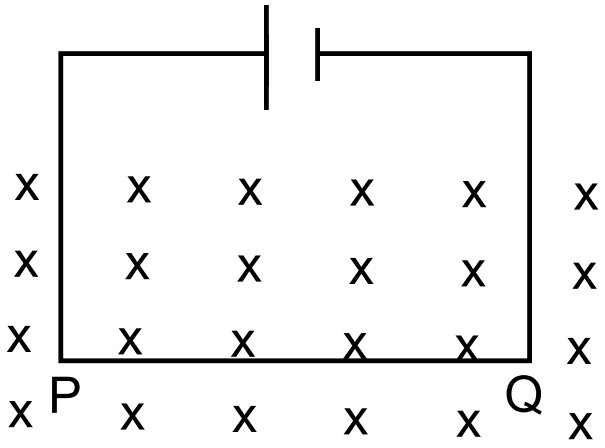
How many time constants will elapse before the power delivered by a battery drops to half of its maximum value in an RC circuit?

Answer

Power $=\text{CV}^2=\text{Q}\times\text{V}$
Now, $\frac{\text{QV}}{2}=\text{QV}\times\text{e}^{\frac{-\text{t}}{\text{RC}}}$
$\Rightarrow\frac{1}{2}=\text{e}^{\frac{-\text{t}}{\text{RC}}}$
$\Rightarrow\frac{\text{t}}{\text{RC}}=-\text{In}\ 0.5$
$\Rightarrow-(-0.69)=0.69.$

Need a full question paper?

Generate a complete, print-ready paper with questions like this in minutes — across 16+ boards, with answer keys.
Start Generating Free

Similar questions

In Young’s double slit experiment, explain with reason in each case, how the interference pattern changes, when :
  1. Width of the slits is doubled.
  2. Separation between the slits is increased.
  3. Screen is moved away from the plane of slits.
Show that the wavelength of electro-magnetic radiation is equal to the de-Broglie wavelength of its quantum (photon).
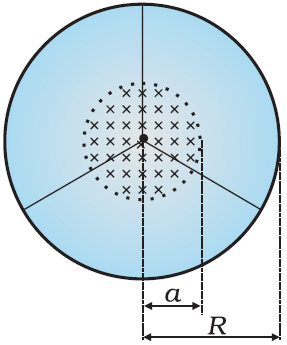
A line charge $\lambda$ per unit length is lodged uniformly onto the rim of a wheel of mass $M$ and radius $R.$ The wheel has light non-conducting spokes and is free to rotate without friction about its axis $($Fig.$). A$ uniform magnetic field extends over a circular region within the rim. It is given by,
$B = – B_0k (r \leq a; a < R)$
$= 0 ($otherwise$)$
What is the angular velocity of the wheel after the field is suddenly switched off?
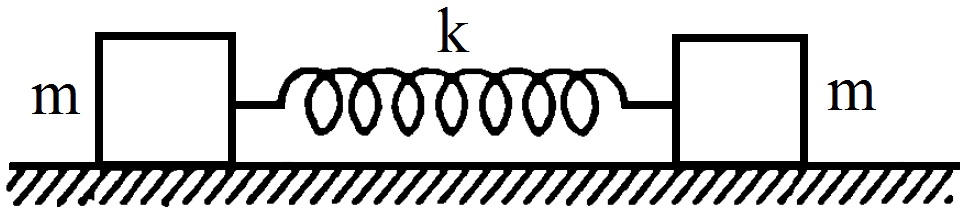
Consider the situation shown in figure Show that if the blocks are displaced slightly in opposite directions and released, they will execute simple harmonic motion. Calculate the time period.
From the erelation $R=R_0 A^{1 / 3}$, where $R_o$ is a constant and $A$ is the mass number of nucleus, show that the nuclear matter density is nearly constant (i.e. independent of A ).
Calculate the ratio of energies of photons produced due to transition of electron of hydrogen atom from its$;$
  1. Second permitted energy level to the first level.
  2. Highest permitted energy level to the second permitted level.
A charge $Q$ is uniformly distributed over a rod of length l. Consider a hypothetical cube of edge l with the centre of the cube at one end of the rod. Find the minimum possible flux of the electric field through the entire surface of the cube.
Use Huygens's principle to explain the formation of diffraction pattern due to a single slit illuminated by a monochromatic source of light.
When the width of the slit is made double the original width, how would this affect the size and intensity of the central diffraction band?
A current of 5.0A exists in the circuit shown in the figure. The wire PQ has a length of 50cm and the magnetic field in which it is immersed has a magnitude of 0.20T. Find the magnetic force acting on the wire PQ.