Question
How much is the diameter of hydrogen atom?

Answer

In hydrogen atom, a proton is in the nucleus and an electron revolves around the nucleus with radius of $0.53 \ Å$, so diameter of atom will approximately $1.06 \ Å$.

Need a full question paper?

Generate a complete, print-ready paper with questions like this in minutes — across 16+ boards, with answer keys.
Start Generating Free

Similar questions

Sometimes it is said that "heat is developed" in a resistance when there is an electric current in it. Recall that heat is defined as the energy being transferred due to temperature difference. Is the statement in quotes technically correct?
Answer the following questions:
The charged currents in the outer conducting regions of the earth’s core are thought to be responsible for earth’s magnetism. What might be the ‘battery’ (i.e., the source of energy) to sustain these currents?
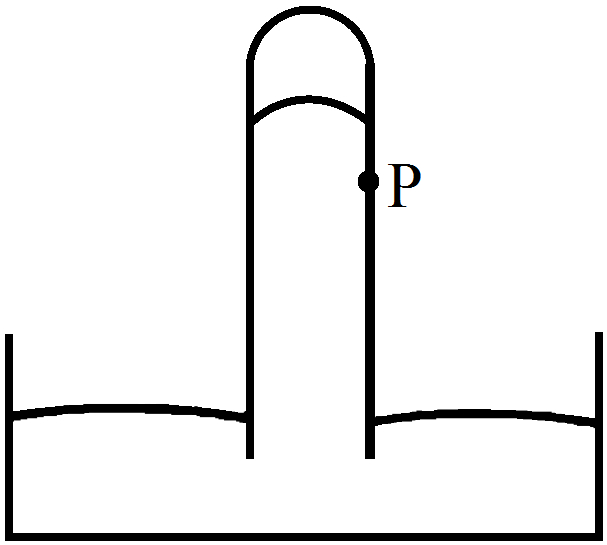
Consider the barometer shown in If a small hole is made at a point P in the barometer tube, will the mercury come out from this hole?
Can we have physical quantities having magnitude and direction which are not vectors?
If in any electric circuit, phase of current lags the phase of potential difference by 90°, then what is the nature of reactance of the circuit?
A long straight current carrying wire passes normally through the centre of circular loop. If the current through the wire increases, will there be an induced emf in the loop? Justify.
The energy of a system in simple harmonic motion is given by $\text{E}=\frac{1}{2}\text{m }\omega^2\text{A}^2.$ Which of the following two statements is more appropriate?
  1. The energy is increased because the amplitude is increased.
  2. The amplitude is increased because the energy is increased.
A room is illuminated by an extended source. The illuminance at a particular portion of a wall can be increased by:
  1. Moving the source.
  2. Rotating the source.
  3. Bringing some mirrors in proper positions.
  4. Changing the colour of the source.
The free surface of a liquid resting in an inertial frame is horizontal. Does the normal to the free surface pass through the centre of the earth? Think separately if the? The free surface of a liquid resting in an inertial frame is horizontal. Does the normal to the free surface pass through the centre of the earth? Think separately if the liquid is.
  1. At the equator.
  2. At a pole.
  3. Somewhere else.
In a rotating body, $\text{a}=\alpha\text{r}$ and $\text{v}=\omega\text{r}.$ Thus $\frac{\text{a}}{\alpha}=\frac{\text{v}}{\omega}.$ Can a co you use the theorems of ratio and proportion studied in algebra so as to write$\frac{\text{a}+\alpha}{\text{a}-\alpha}=\frac{\text{v}+\omega}{\text{v}-\omega}$