Question
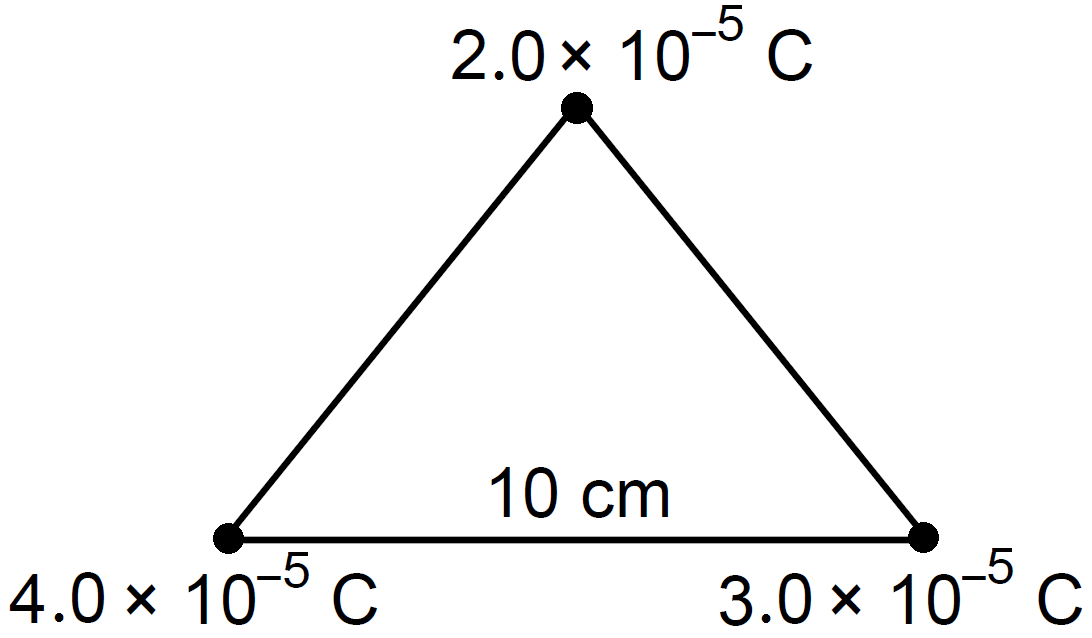
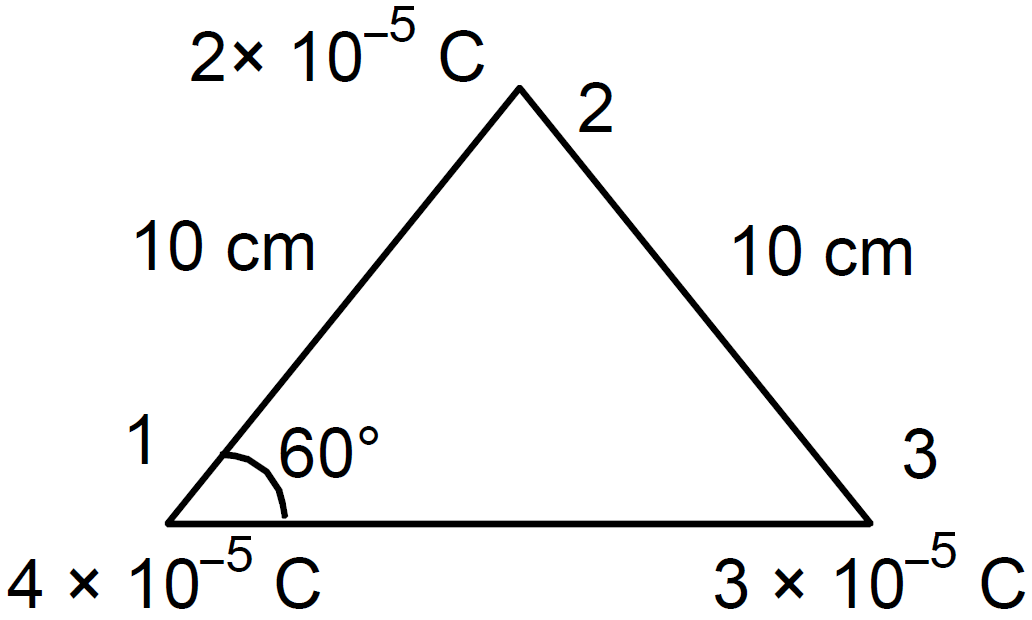
How much work has to be done in assembling three charged particles at the vertices of an equilateral triangle as shown in figure?
Answer

Amount of work done is assembling the charges is equal to the net potential energy

So, P.E. $=\text{U}_{12}+\text{U}_{13}+\text{U}_{23}$
$=\frac{\text{Kq}_1\text{q}_2}{\text{r}_{12}}+\frac{\text{Kq}_1\text{q}_3}{\text{r}_{13}}+\frac{\text{Kq}_2\text{q}_3}{\text{r}_{23}}$
$=\frac{\text{K}+10^{10}}{\text{r}}[4\times2+4\times3+3\times2]$
$=\frac{9\times10^9\times10^{10}}{10^{-1}}(8+12+6)$
$=9\times26$
$=234\text{J}$

Need a full question paper?

Generate a complete, print-ready paper with questions like this in minutes — across 16+ boards, with answer keys.
Start Generating Free

Similar questions

Two waves, each having a frequency of 100Hz and a wavelength of 2.0cm, are travelling in the same direction on a string. What is the phase difference between the waves,
  1. If the second wave was produced 0.015s later than the first one at the same place.
  2. If the two waves were produced at the same instant but the first one was produced a distance 4.0cm behind the second one?
  3. If each of the waves has an amplitude of 2.0mm, what would be the amplitudes of the resultant waves in part (a) and (b)?
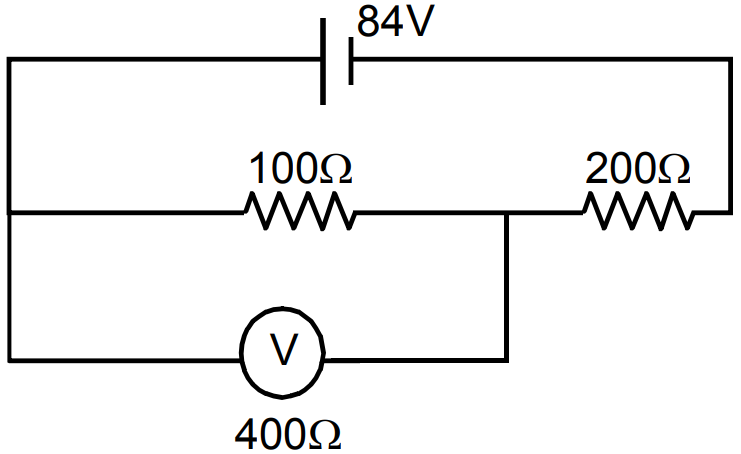
A voltmeter of resistance $400\Omega$ is used to measure the potential difference across the $100\Omega$ resistor in the circuit shown in the figure. (a) What will be the reading of the voltmeter? (b) What was the potential difference across $100\Omega$ before the voltmeter was connected?

A spherical capacitor has an inner sphere of radius 12cm and an outer sphere of radius 13cm. The outer sphere is earthed and the inner sphere is given a charge of 2.5µC. The space between the concentric spheres is filled with a liquid of dielectric constant 32.
  1. Determine the capacitance of the capacitor.
  2. What is the potential of the inner sphere?
  3. Compare the capacitance of this capacitor with that of an isolated sphere of radius 12cm. Explain why the latter is much smaller.
(a) A point-image (object) is placed on the principal axis of a convex spherical surface of radius of curvature $R$, the refractive index of the medium on one side of this surface is $n _1$ and the refractive index of the medium on the other side is $n_2$, where $n_2>n_1$. For this, draw a ray diagram and derive the relation between object distance $(u)$, image distance $(v)$ and radius of curvature $( R )$ for refraction from rarer medium to denser medium on a convex spherical surface.
(b) Use the above relation in terms of $n_1$ and $n_2$, to obtain the condition for the position of the object and the radius of curvature when a real image is formed.
What is the difference between cathode rays and beta rays? When the two are travelling in space, can you make out which is the cathode ray and which is the beta ray?
A coil of inductance 0.50H and resistance 100Ω is connected to a 240V, 50Hz ac supply.
  1. What is the maximum current in the coil?
  2. What is the time lag between the voltage maximum and the current maximum?
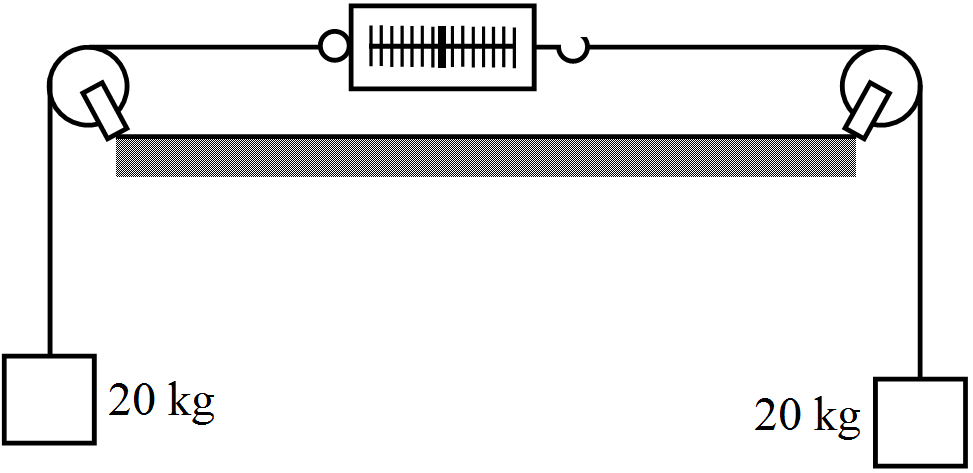
Figure shows a light spring balance connected to two blocks of mass 20kg each. The graduations in the balance measure the tension in the spring.
  1. What is the reading of the balance?
  2. Will the reading change if the balance is heavy, say 2.0kg?
  3. What will happen if the spring is light but the blocks have unequal masses?
​​​​​​​
The conductivity of an intrinsic samiconductor depends on temperature as $\sigma=\sigma_0\text{ e}^{\frac{-\Delta\text{E}}{2\text{kT}}}$ where $\sigma_0$ is a constant. Find the temperature at which the conductivity pf an intrinsic germanium semiconductor will be double of its value at T = 300K. Assume that the gap for germanium is 0.650eV and remains constant as the temperature is increased.
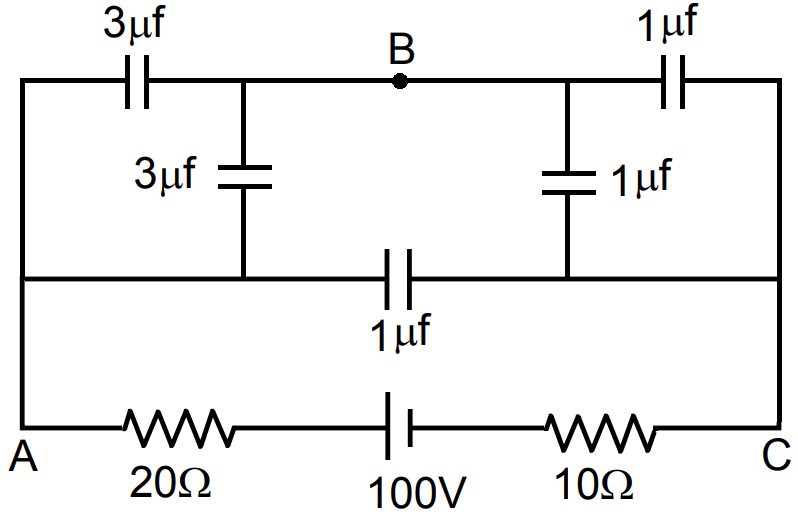
Find the potential difference between the points A and B and between the points B and C of the figure. in steady state.

Assume the dipole model for earth's magnetic field B which is given by BV = vertical component of magnetic field $=\frac{\mu_0}{4\pi}\frac{2\text{m}\cos\theta}{\text{r}^3}$
BH = Horizontal component of magnetic field $=\frac{\mu_0}{4\pi}\frac{\sin\theta\text{m}}{\text{r}^3}$
θ = 90º - lattitude as measured from magnetic equator. Find loci of points for which,
  1. |B| is minimum,
  2. Dip angle is zero,
  3. Dip angle is ± 45º.