MCQ
How much work is required to making a soap bubble solution whose radius is r?
  • A
    $4 \pi r^2 T$
  • $8 \pi r^2 T$
  • C
    $2 \pi r^2 T$
  • D
    $\pi r^2 T$

Answer

Correct option: B.
$8 \pi r^2 T$
B

Need a full question paper?

Generate a complete, print-ready paper with questions like this in minutes — across 16+ boards, with answer keys.

Start Generating Free

Similar questions

In terms of potential difference $V$, electric current $I$, permittivity $\varepsilon_0$, permeability $\mu_0$ and speed of light $c$, the dimensionally correct equation$(s)$ is(are)

$(A)$ $\mu_0 I ^2=\varepsilon_0 V ^2$ $(B)$ $\varepsilon_0 I =\mu_0 V$ $(C)$ $I =\varepsilon_0 cV$ $(D)$ $\mu_0 cI =\varepsilon_0 V$
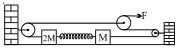
In the diagram shown, no friction at any contact surface. Initially, the spring has no deformation. What will be the maximum deformation in the spring? Consider all the strings to be sufficiency large. Consider the spring constant to be $K$.
Select the incorrect relation. (Where symbols have their usual meanings)
A body of mass $1.0\,kg$ is falling with an acceleration of $10 \,m/se{c^2}$. Its apparent weight will be ......... $kg\,wt$ $(g = 10\,m/{\sec ^2})$ 
A satellite of the earth is revolving in circular orbit with a uniform velocity $V.$ If the gravitational force suddenly disappears, the satellite will
If the external force acting on a system have zero resultant, the centre of mass:
A particle moves in a circle of radius $R$, with a constant speed $v$. Then, during a time interval $[\pi R/3v]$, which of the following is true?
An ideal gas expands from volume $V_1$ to $V_2$. This may be achieved by either of the three processes: isobaric, isothermal and adiabatic. Let $\Delta U$ be the change in internal energy of the gas, $Q$ be the quantity of heat added to the system and $W$ be the work done by the system on the gas. Identify which of the following statements is false for $\Delta U$?
Heat is being supplied at a constant rate to the sphere of ice which is melting at the rate of $0.1 \,gm / s$. It melts completely in $100 \,s$. The rate of rise of temperature thereafter will be ............ $^{\circ} C / s$
Consider the following two statements:
$A.$ Linear momentum of the system remains constant.
$B.$ Centre of mass of the system remains at rest.