MCQ
How much work is required to making a soap bubble solution whose radius is r?
  • A
    $4 \pi r^2 T$
  • $8 \pi r^2 T$
  • C
    $2 \pi r^2 T$
  • D
    $\pi r^2 T$

Answer

Correct option: B.
$8 \pi r^2 T$
B

Need a full question paper?

Generate a complete, print-ready paper with questions like this in minutes — across 16+ boards, with answer keys.

Start Generating Free

Similar questions

As the temperature of a conductor increases, its resistivity and conductivity change. The ratio of resistivity to conductivity:
  1. Increases.
  2. Decreases.
  3. Remains constant.
  4. May increase or decrease, depending on the actual temperature.
Two particles are projected from a tower in opposite directions horizontally with speed $10\,m / s$ each. At $t=1\,s$ match the following two columns.
Column $I$ Column $II$
$(A)$ Relative acceleration between two $(p)$ $0$ SI unit
$(B)$ Relative velocity between two $(q)$ $5$ SI unit
$(C)$ Horizontal distance between two $(r)$ $10$ SI unit
$(D)$ Vertical distance between two $(s)$ $20$ SI unit
The motion of a particle of mass m is given by $\text{x}=0$ for $\text{t} < 0\ \text{s},$ $\text{x}(\text{t})=\text{A}\sin4\text{p}\ \text{t}$ for $0<\text{t}<(1/ 4)\ \text{s}(\text{A}>\text{o}),$ and $\text{x}=0$ for $\text{t}>(1/4)\ \text{s}.$ Which of the following statements is true?
  1. The force at t = (1/8) s on the particle is $–16\pi^2 \text{A m.}$
  2. The particle is acted upon by on impulse of magnitude $4π^2\text{A m}$ at $\text{t} = 0$ s and t = (1/4) s.
  3. The particle is not acted upon by any force.
  4. The particle is not acted upon by a constant force.
  5. There is no impulse acting on the particle.
Cooking gas containers are kept in a lorry moving with uniform speed. The temperature of the gas molecules inside will.
The ratio of specific heats $(\gamma )$ of a ideal gas is given by
A car, starting from rest, accelerates at the rate $\alpha$ through a distance $d$, then continues at a constant speed for time $t$ and then decelerates at the rate of $\alpha/2$ to come to rest. If the total distance traveled is $15\, d$, then $d=$
The angular speed of truck wheel is increased from $900\, rpm$ to $2460\, rpm$ in $26$ seconds. The number of revolutions by the truck engine during this time is

(Assuming the acceleration to be uniform).

Match the thermodynamic processes taking place in a system with the correct conditions. In the table: $\Delta Q$ is the heat supplied, $\Delta W$ is the work done and $\Delta U$ is change in internal energy of the system
Process Condition
$(I)$ Adiabatic $(A)\; \Delta W =0$
$(II)$ Isothermal $(B)\; \Delta Q=0$
$(III)$ Isochoric $(C)\; \Delta U \neq 0, \Delta W \neq 0 \Delta Q \neq 0$
$(IV)$ Isobaric $(D)\; \Delta U =0$
A graph of the square of the velocity against the square of the acceleration of a given simple harmonic motion is
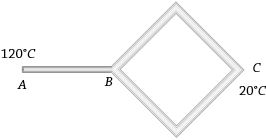
Five identical rods are joined as shown in figure. Point $A$ and $C$ are maintained at temperature $120^o C$ and $20^o C$ respectively. The temperature of junction $B$ will be....... $^oC$