Question
How much work will be required to bring a test charge q, one em along the equatorial axis of an electric dipole?

Answer

Since the potential at every point of the equatorial axis of a dipole is zero, therefore the potential difference between any two of its points $=0$, so the work $W =q \times \Delta V$ $=q \times 0=0$

Need a full question paper?

Generate a complete, print-ready paper with questions like this in minutes — across 16+ boards, with answer keys.

Start Generating Free

Similar questions

Given the mass of iron nucleus as $55.85 u$ and $A =56$, find the nuclear density?
A point charge +Q is placed at point O as shown in the figure. Is the potential difference VA – VB positive, negative or zero?

Answer the following questions:
The earth’s field departs from its dipole shape substantially at large distances (greater than about 30,000 km). What agencies may be responsible for this distortion?
The binding energy per nucleon of the two nuclei A and B are 4 MeV and 8.2 MeV. Which of the two nuclei is more stable?
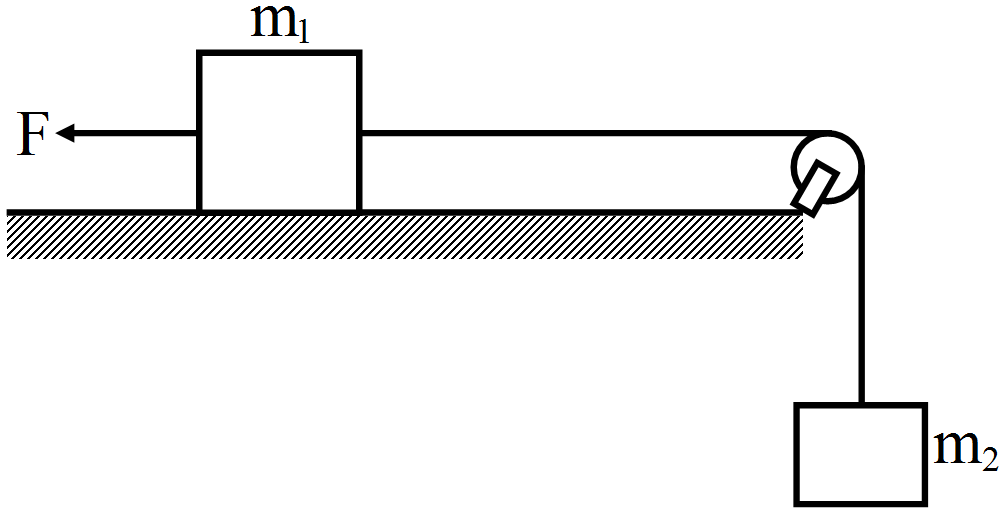
Consider the situation shown in The force F is equal to the $\frac{\text{m}_2\text{g}}{2}$ If the area of cross-section of the string is A and its Young's modulus Y, find the strain developed in it. The string is light and there is no friction anywhere.

What is the minimum possible value of electric charge?
How does the value of capacitance depend on the condition of the dielectric material when the space between the plates of a parallel plate capacitor is partially filled with a dielectric material?
The ratio $\frac{\text{Stress}}{\text{strain}}$ remains constant for small deformation of a metal wire. When the deformation is made larger, will this ratio increase or decrease?
A pendulum clock gives correct time at the equator. Will it gain time or loose time as it is taken to the poles?
There is a potential of 10V on the surface of a charged spherical shell of radius 10 cm. Write the value of potential at a distance of 5 cm from its centre.