Question
How resistivity of material depends on its temperature. Write its empirical formula.

Answer

$\rightarrow $ The resistivity of a material depends on temperature. Different materials do not exhibit the same dependence on temperature.
$\rightarrow $ Over a limited range of temperatures $($not too large$),$ the resistivity of a metallic conductor is given by,
$\rightarrow \rho_{ T }= \rho _0\left[1+\alpha\left( T - T _0\right)\right]$
where,
$\rho _{ T }=\text { the resistivity at temp. } T$
$\rho _0=\text { the resistivity at reference temp. }$
$\alpha=\text { temperature co-efficient of resistivity }$
$ \text { (unit }{ }^{\circ} C ^{-1} \text { or } K ^{-1} \text { ) }$
$T =\text { given temperature }$
$T _0=\text { reference temperature }$

Need a full question paper?

Generate a complete, print-ready paper with questions like this in minutes — across 16+ boards, with answer keys.
Start Generating Free

Similar questions

What physical quantity is the same for $Χ-$rays of wavelength $10^{-10}m,$ red light of wavelength $6800\mathring{\text{A}}$ and radio waves of wavelength $500m?$
A convex lens of diameter 8.0cm is used to focus a parallel beam of light of wavelength 620nm. If the light be focused at a distance of 20cm from the lens, what would be the radius of the central bright spot formed?
The torque on a current loop is zero if the angle between the positive normal and the magnetic field is either $\theta=0^\circ$ or $\theta=180^\circ$ In which of the two orientations, the equilibrium is stable?
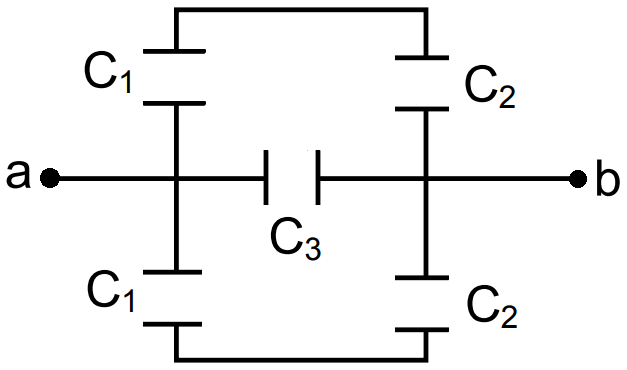
Find the equivalent capacitance of the syatem shown in figure between the points $a$ and $b.$
At what speed the volume of an object shrinks to half its rest value?
Derive the formula for the magnetic fieid produced by a current-carrying circular coil as a magnetic dipole on its axis and equator. (Perpendicular bisector.)
Explain the variation of resistivity with temperature in pure-semiconductors.
In a Michelson experiment for measuring speed of light, the distance travelled by light between two reflections from the rotating mirror is $4.8\ km.$ The rotating mirror has a shape of a regular octagon. At what minimum angular speed of the mirror $($other than zero$)$ the image is formed at the position where a non$-$rotating mirror forms it?
Calculate the dimensions of:
  1. $\int\vec{\text{E}}.\vec{\text{dl}}.$
  2. $\text{vBl}$
  3. $\frac{\text{d}\psi_{\text{B}}}{\text{dt}}$
The symbols have their usual meanings.
A parallel plate capacitor with air between the plates has a capacitance of 8 pF. The separation between the plates is now reduced by half and the space between them is filled with a medium of dielectric constant 5. Calculate the value 
of capacitance of the capacitor in the second case.