Question
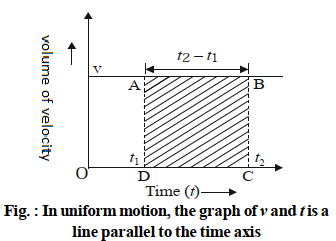
How to find displacement from velocity-time graph? Explain.

Need a full question paper?

Generate a complete, print-ready paper with questions like this in minutes — across 16+ boards, with answer keys.

Start Generating Free

Similar questions

The displacement vector of a particle of mass m is given by $\text{r}\text{(t})=\hat{\text{i}}\text{A}\cos\omega\text{t}+\hat{\text{j}}\text{B}\sin\omega\text{t}.$

Show that the trajectory is an ellipse.
A boy travelling in an open car moving on a levelled road with constant speed tosses a ball vertically up in the air and catches it back. Sketch the motion of the ball as observed by a boy standing on the footpath. Give explanation to support your diagram.
Find out the increase in moment of inertia I of a uniform rod $($coefficient of linear expansion $\alpha)$ about its perpendicular bisector when its temperature is slightly increased by $\Delta\text{T}.$
A particle is released from the top of an incline of height h. Does the kinetic energy of the particle at the bottom of the incline depend on the angle of incline? Do you need any more information to answer this question in Yes or No?
Prove that for an earth satellite, the ratio of its velocity at apogee (when farthest from earth) to its velocity at perigee (when nearest to earth) is equal to the inverse ratio of its distances from apogee and perigee.
The volume of a liquid flowing out per second of a pipe of length l and radius r is written by a student as,
$\text{v}=\frac{\pi}{8}\frac{\text{Pr}^4}{\eta\text{l}}$
where P is the pressure difference between the two ends of the pipe and $\eta$ is coefficent of viscosity of the liquid having dimensional formula ML-1 T-1.
Check whether the equation is dimensionally correct.
Is friction necessary for a body to roll? What is the minimum friction required for a disc of mass M and radius r to roll on an inclined plane?
A rocket with a lift-off mass 20,000kg is blasted upwards with an initial acceleration of 5.0ms-2. Calculate the initial thrust (force) of the blast.
A simple pendulum of length lm has a wooden bob of mass 1kg. It is struck by a bullet of mass 10-2kg moving with a speed of 2 x 10²m/ sec. The bullet gets embedded into the bob. Obtain the height to which the bob rises before swinging back.
State parallelogram law of vector addition. Show that resultant of two vectors A and B inclined at an angle $\theta$ is $\text{R}=\sqrt{\text{A}^2+\text{B}^2+2\text{AB}\cos\theta}.$