MCQ
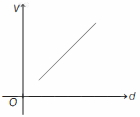
How will the voltage $(V)$ between the two plates of a parallel plate capacitor depend on the distance $(d)$ between the plates, if the charge on the capacitor remains the same?
  • A

  • B


  • D

Answer

Correct option: C.

c
$(c)$ From $C=\frac{q}{V}$

We have, $V=\frac{q}{C}=\frac{q d}{\varepsilon_{0} A}$ or $V \propto d$

Hence, graph is a straight line.

When both plates are touched $(d=0)$,

system still have some capacity $(C \neq 0)$.

So, from $C=\frac{q}{V}$ we can see that at very small seperations $V \neq \infty$ or graph does not have any values for very small $d$.

$\therefore V$ versus $d$ graph is as shown below :
Need a full question paper?

Generate a complete, print-ready paper with questions like this in minutes — across 16+ boards, with answer keys.
Start Generating Free

Similar questions

The potential difference $ V$  and the current i flowing through an instrument in an $ ac$ circuit of frequency $ f $ are given by $V = 5\,cos\, \omega \,t$ volts and $I = 2\, sin \,$ $ \omega$ $ t $ amperes (where $\omega$ $= 2$ $\pi\, f $ ). The power dissipated in the instrument is......$W$
The ratio of the speed of sound in nitrogen gas to that in helium gas, at $300 K$ is
A ray passes through a prism of angle $60^o$ in minimum deviation position and suffers a deviation of $30^o $. What is the angle of incidence on the prism......$^o$
Identify the function which represents a nonperiodic motion.
A plane progressive wave is represented by the equation $y = 0.1\sin \left( {200\pi t - \frac{{20\pi x}}{{17}}} \right)$ where y is displacement in $m$, $ t$ in second and $x$ is distance from a fixed origin in meter. The frequency, wavelength and speed of the wave respectively are
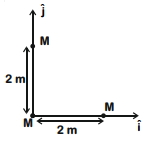
Three identical spheres, each of mass $M ,$ are placed at the corners of a right angle triangle with mutually perpendicular sides equal to $2 \;m$ (see figure). Taking the point of intersection of the two mutually perpendicular sides as the origin, find the position vector of centre of mass.
A point charge $ + q$ is placed at the centre of a cube of side $L$. The electric flux emerging from the cube is
$10$ wires (same length, same area, same material) are connected in parallel and each has $1$ $\Omega$ resistance, then the equivalent resistance will be .............. $\Omega$
In a communication system, noise is most likely to affect the signal
The displacement of a particle executing periodic motion is given by :
$y = 4cos^2\,(t/2)sin\,(1000t)$
This expression may be considered to be a result of superposition of