Question
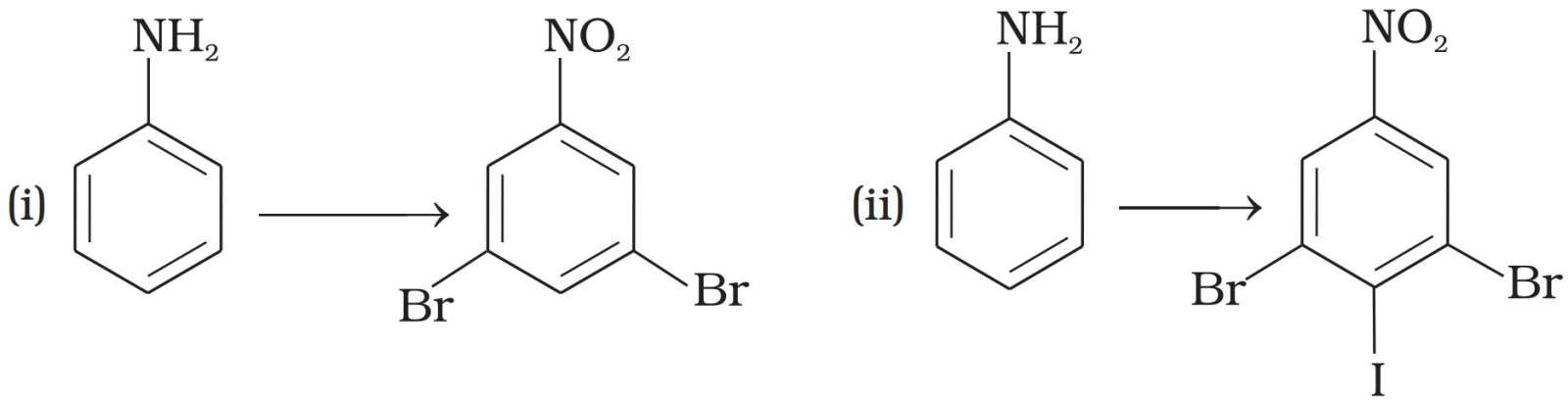
✓
Answer
Get the step-by-step solution for this question inside the Vidyadip app.
Get the answer in the appNeed a full question paper?
Generate a complete, print-ready paper with questions like this in minutes — across 16+ boards, with answer keys.
Explore more
Similar questions
How are different aromatic compounds synthesized by benzene diazonium chloride? Explain with examples.
A hydrocarbon ‘A’, (C4H8) on reaction with HCl gives a compound ‘B’, (C4H9Cl), which on reaction with 1 mol of NH3 gives compound ‘C’, (C4H11N). On reacting with NaNO2 and HCl followed by treatment with water, compound ‘C’ ields an optically active alcohol, ‘D’. Ozonolysis of ‘A’ gives 2 moles of acetaldehyde. Identify the compounds ‘A’ to ‘D’. Explain the reactions involved.
Match the complex ions given in Column I with the hybridisation and number of unpaired electrons given in Column II and assign the correct code:
Code:
| | Column I (Complex ion) | | Column II (Hybridisation, number of unpaired electrons) |
| a. | [Cr(H2O)6]3+ | 1. | dsp2, 1 |
| b. | [Co(CN)4]2- | 2. | sp3d2, 5 |
| c. | [Ni(NH3)6]2+ | 3. | d2sp3, 3 |
| d. | [MnF6]4- | 4. | sp3, 4 |
| | | 5. | sp3d2, 2 |
- A (3), B (1), C (5), D (2).
- A (4), B (3), C (2), D (1).
- A (3), B (2), C (4), D (1).
- A (4), B (1), C (2), D (3).
A colorless substance ' $A$ ' $\left( C _6 H _7 N\right)$ is sparingly soluble in water and gives a water-soluble compound ' B ' on treating with a mineral acid. On reacting with CHCl 3 and alcoholic potash ' A ' produces an obnoxious smell due to the formation of compound ' C '. The reaction of ' A ' with benzene sulphonyl chloride gives compound ' D ' which is soluble in alkali. With $NaNO _2$ and HCl , ' A ' forms compound ' E ' which reacts with phenol in alkaline medium to give an orange dye ' $F$ '. Identify compounds ' $A$ ' to ' $F$ '.
→How much electricity in terms of Faraday is required to produce:
(i) 20.0 g of Ca from molten $CaCl_{2}$, (ii) 40.0 g of Al from molten $Al_{2}O_{3}$.
→(i) 20.0 g of Ca from molten $CaCl_{2}$, (ii) 40.0 g of Al from molten $Al_{2}O_{3}$.
A steady current of 2 amperes was passed through two electrolytic cells X and Y connected in series containing electrolytes $FeSO_{4}$ and $ZnSO_{4}$ until 2.8 g of Fe deposited at the cathode of cell X. How long did the current flow? Calculate the mass of Zn deposited at the cathode of cell Y. (Molar mass: $Fe = 56 g mol^{-1}, Zn = 65.3 g mol^{-1}, 1 F = 96500 C mol^{-1}$)
→- What type of deviation is shown by a mixture of ethanol and acetone? Give reason.
- A solution of glucose (molar mass = 180 g mol–1) in water is labelled as 10% (by mass). What would be the molality and molarity of the solution?
(Density of solution = 1.2 g mL–1).

Attempt any five of the following:
(a) Name the enzyme which convert surcrose into glucose and fructose.
(b) i. Name any two bases which are common to both DNA and RNA.
ii. Which vitamin deficiency causes:
1. Bone deformities in children?
2. Pernicious anaemia?
(c) What are heterocyclic bases?
(d) Write the name of linkage joining two monosaccharides.
(e) Name the purines present in DNA.
(f) Give an example of fibrous protein.
(g) Of the two bases named below, which one is present in RNA and which one is present in DNA?
i. Thymine
ii. Uracil
(a) Name the enzyme which convert surcrose into glucose and fructose.
(b) i. Name any two bases which are common to both DNA and RNA.
ii. Which vitamin deficiency causes:
1. Bone deformities in children?
2. Pernicious anaemia?
(c) What are heterocyclic bases?
(d) Write the name of linkage joining two monosaccharides.
(e) Name the purines present in DNA.
(f) Give an example of fibrous protein.
(g) Of the two bases named below, which one is present in RNA and which one is present in DNA?
i. Thymine
ii. Uracil
Write short notes on the following :
(i) Kolbe's electrolytic reaction
(ii) Hell-Volhard-Zelinsky reaction
(iii) Esterification reaction
(iv) Decarboxylation reaction(v) Hunds-Diecker reaction
(i) Kolbe's electrolytic reaction
(ii) Hell-Volhard-Zelinsky reaction
(iii) Esterification reaction
(iv) Decarboxylation reaction(v) Hunds-Diecker reaction