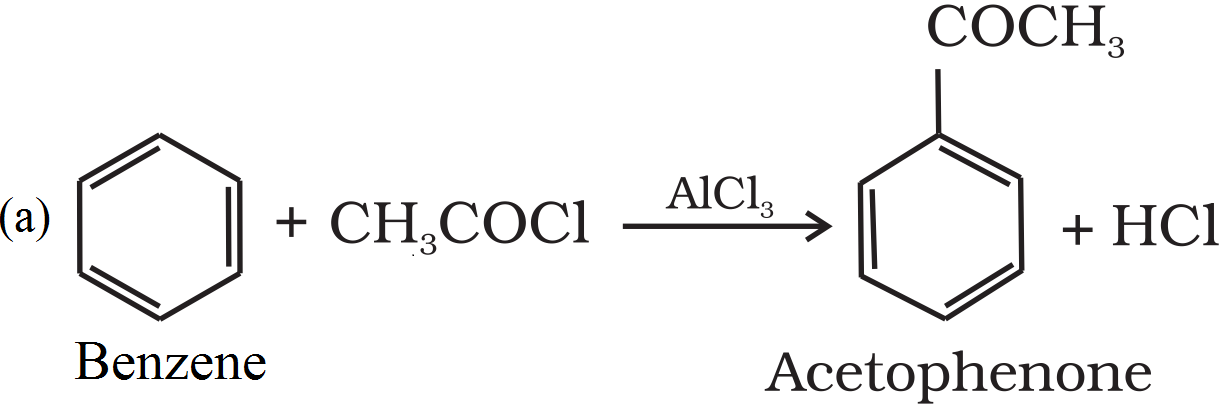
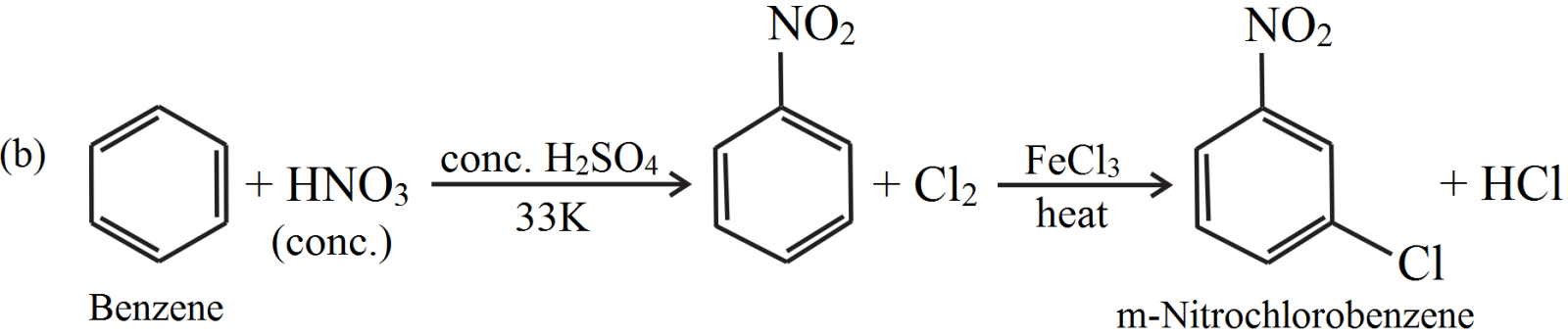
Question
  1. How will you convert benzene into:
  1. Acetophenone?
  2. m-nitrochlorobenzene?
  1. Write the structures of products obtained by ozonolysis of pent-2-ene.

Need a full question paper?

Generate a complete, print-ready paper with questions like this in minutes — across 16+ boards, with answer keys.

Start Generating Free

Similar questions

Arrange the bonds in order of increasing ionic character in the molecules: LiF, K2O, N2 , SO2 and ClF3.
Calculate the pH of a solution containing 0.1M acetic acid and 0.1M benzoic acid, Ka for CH3COOH and C6H5COOH are 1.8 × 10⁻⁵ and 6.5 × 10⁻⁵ respectively.
1. Two litres of an ideal gas at a pressure of 10 atm expands isothermally at $25^{\circ} C$ into a vacuum until itstotal volume is 10 litres. How much heat is absorbed and how much work is done in the expansion against a constant external pressure of 1 atm?
2. What is free energy in terms of thermodynamics?
3. Define a system.
Yellow light emitted from a sodium lamp has a wavelength $(\lambda)$ of 580 nm. Calculate the frequency (ν) and wavenumber $(\bar{\text{v}})$ of the yellow light.
$\text{X(g)}+3\text{Y(g)}\rightleftharpoons2\text{Z(g)};$ $\Delta\text{H}=-40\text{kJ}$ and so of X, Y and Z are 60, 40 and 50kJ-1 mol-1 respectively. Calculate the temperature above or below which reaction become feasible?
Some processes are given below. What happens to the process if it is subjected to a change given in the brackets?

  1.  

(Pressure is increased)

  1. Dissolution of NaOH in water (Temperature is increased.)
  2. $\text{N}_2(\text{g})+\text{O}_2(\text{g})\rightleftharpoons2\text{NO}(\text{g})-180.7\text{KJ}$ (Pressure is increased and temperature is decreased.)
  1. What is the oxidation number of 'S'in H2SO5
  2. Balance the following equation:

$\text{Zn}\text{(s)}+\text{NO}_3^-\text{(aq)}\xrightarrow{ \ \ \ \ \ \ \ \ }\text{Zn}^{2+}\text{(aq)}+\text{NH}_4^+\text{(aq)}+\text{H}^+$ (Acidic medium)
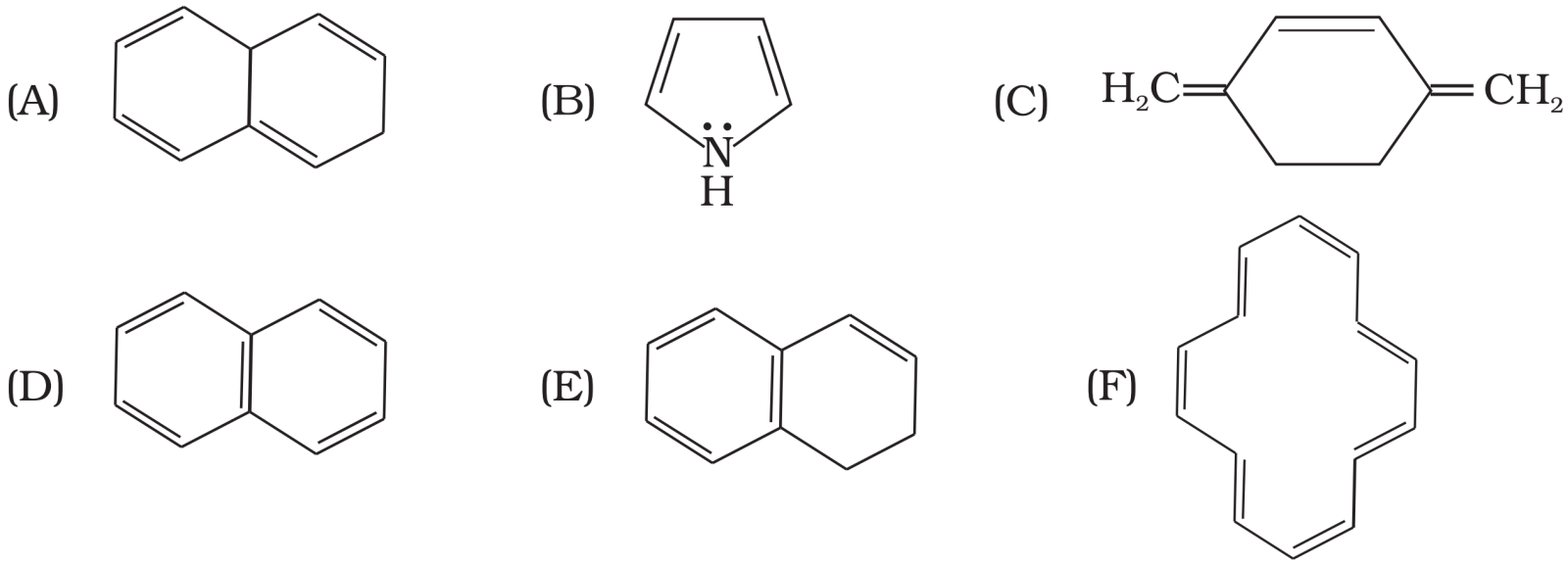
Which of the following compounds are aromatic according to Huckel’s rule?

“Stability of carbocations depends upon the electron releasing inductive effect of groups adjacent to positively charged carbon atom involvement of neighbouring groups in hyperconjugation and resonance.”
Write structures of various carbocations that can be obtained from 2-methylbutane. Arrange these carbocations in order of increasing stability.
  1. Give one example of position isomerism.
  2. What are electrophiles? Give one example of electrophilic substitution reaction.
  3. Write the chemistry of Lassaigne's test for qualitative analysis of nitrogen.