Question
How will you convert carboxylic acids and esters to primary alcohols? Explain with suitable examples.

Answer

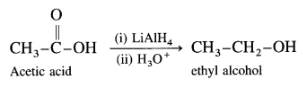
Carboxylic acids and esters are not easily reduced by catalytic hydrogenation or by $NaBH_4.$ However, relatively more reactive and an expensive $LiAlH_4$ is used to convert carboxylic acids and esters to primary alcohols. When acetic acid is reduced in the presence of $LiAlH_4$ and followed by their acid hydrolysis, ethyl alcohol is obtained.
Image
When ethyl acetate is reduced in the presence of $LiA _4 H _4$ and followed by their acid hydrolysis. $n$ propyl alcohol and ethyl alcohol is obtained.
Image
[Since $LiA1H _4$ is an expensive reagent. commercially acids are reduced to alcohol by converting them to esters, followed by their reduction. $($catalytic hydrogenation$)$
$R - COOH \xrightarrow[ H ^{+}]{ R \ ^{\prime} OH } RCOOR \ ^{\prime} \xrightarrow[\text { Catalyst }]{ H _2} RCH _2 OH + R \ ^{\prime} OH$

Need a full question paper?

Generate a complete, print-ready paper with questions like this in minutes — across 16+ boards, with answer keys.

Start Generating Free

Similar questions

Answer in brief.How much heat is evolved when $12\ g$ of $CO$ reacts with $NO_2$​​​​​​​? The reaction is:
$4CO_{(g)} 2NO_{2(g)} \rightarrow 4CO_{2(g)} + N_{2(g)}, \triangle _rH^\circ = - 1200 kJ$
Calculate the work done during synthesis of $NH_3$ in which volume changes from $8.0\ dm3$ to $4.0\ dm^3​​​​​​​$​​​​​​​ at a constant external pressure of $43$ bar. In what direction the work energy flows?
The osmotic pressure of $CaCl_2$​​​​​​​ and urea solutions of the same concentration at the same temperature are respectively $0.605$ atm and $0.245$ atm. Calculate van’t Hoff factor for $CaCl_2​​​​​​​$​​​​​​​.
Show that the rate of reaction is the same whether expressed in terms of the rate of consumption of any reactant or of the formation of any product.
$2 N _2 O _{5( g )} \rightarrow 4 NO _{2( g )}+ O _{2( g )}$
The concentrations of reactants and products at different time intervals are given in the following table :
Concentrations of various species at different times for the reaction $N _2 O _{5( g )} \rightarrow 4 NO _{2( g )}+ O _{2( g )}$ :
$Time /s$ $\left[ N _2 O _5\right] / M$ $\left[ NO _2\right] / M$ $\left[ O _2\right] / M$
$0$ $0.0300$ $0$ $0$
$200$ $0.0213$ $0.0174$ $0.00435$
$400$ $0.0152$ $0.0296$ $0.00740$
$600$ $0.0108$ $0.0384$ $0.00960$
Explain the reactivity of group 16 elements towards halogens.
Aluminium crystallizes in cubic close packed structure with unit cell edge length of $353.6\ pm$ . What is the radius of Al atom ? How many unit cells are there in $1.00 cm^3$ of Al ?
Explain the following properties of group $16$ elements:
$(i)$ Electronegativity $(ii)$ Melting and boiling points $(iii)$ Metallic character $(iv)$ Allotropy
Explain with a diagram the formation of F-centers
Determine whether the following reaction is spontaneous under standard state conditions.
$2 H_2O_{(l)} + O_{2(g)} \rightarrow 2H_2O_{2(l)}$
if $\triangle H^0 = 196 kJ, \triangle S^0 = -126 J/K$
Does it have a cross-over temperature?
Write the IUPAC names of the following structures :

Image