Question
How will you distinguish between conc. HCl and conc. $H_2SO_4?$

Answer

Conc. HCl and Conc. $H_2SO_4:$
S.No. Conc. HCl Conc. $H_2SO_4$
1. Addition to silver nitrate : When conc. HCI is added to silver nitrate white ppt. of silver chloride are formed.
$AgNO _3+ HCl \longrightarrow AgCl + HNO _3$
White ppt. of silver chloride dissolve in excess of ammonium hydroxide.
Addition to copper :
Conc. Sulphuric acid is added to copper and heated. Sulphur dioxide, which is colourless gas with the smell of burnt sulphur is evolved.
$
Cu +2 H _2 SO _4 \longrightarrow CuSO _4+2 H _2 O + SO _2
$
$SO _2$ gas turns $K _2 Cr _2 O _7$ paper green.
2. A glass rod dipped in conc. HCl is brought in contact with ammonia gas, curdy white fumes of ammonium chloride is seen around the glass rod. Glucose when conc. Sulphuric acid
$\underset{\text { blue }}{ CuSO _4 \cdot 5 H _2 O } \xrightarrow{\text { conc } \cdot H _2 SO _4} CuSO _4+\underset{\text { white }}{5 H _2 O }$

Need a full question paper?

Generate a complete, print-ready paper with questions like this in minutes — across 16+ boards, with answer keys.
Start Generating Free

Similar questions

A gas ‘A’ reacts with another gas ‘B’ in the presence of a catalyst to give a colourless gas ‘C’. The gas ‘C’ when comes in contact with air produces a brown gas ‘D’. The solution of ‘A’ in water turns red litmus blue. Explain the observations.
How will you prove that Hydrochloric acid contains (i) Hydrogen (ii) Chlorine?
Write equations for the reactions. 
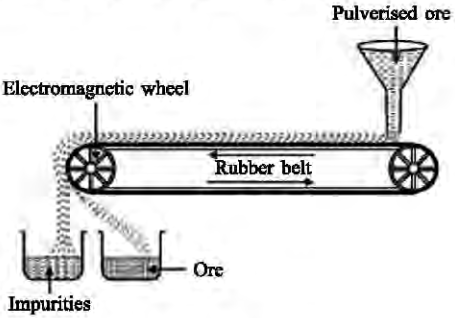
Look at the given picture carefully and answer the related questions:
Image
(i) Which step of metallurgy is performed by this method?
(ii) Give two examples of ores related to this method.
(iii) Write the property of ore and the principle of this process.
(iv) Name two other processes that come under the step of metallurgy in (i).
Water decomposes to $O _2$ and $H _2$ under suitable conditions as represented by the equation below:
$2 H _2 O \rightarrow 2 H _2+ O _2$
(a) If $2500 cm ^3$ of $H _2$ is produced, what volume of $O _2$ is liberated at the same time and under the same conditions of temperature and pressure?
(b) The $2500 cm ^3$ of $H _2$ is subjected to $2$ times an increase in pressure (temp. remaining constant). What volume of $H _2$ will now occupy?
(c) Taking the value of $H _2$ calculated in $5$(b), what changes must be made in Kelvin (absolute) temperature to return the volume to $2500 cm ^3$ pressure remaining constant.
Calculate the mass of substance 'A' which in gaseous form occupies $10$ litres at $27 {}^\circ C$ and $700\ mm$ pressure. The molecular mass of 'A' is $60.$
i. A compound has the following percentage composition by mass: carbon $14.4 \%$, hydrogen $1.2 \%$, and chlorine $84.5 \%$. Determine the empirical formula of this compound. Work correctly to $1$ decimal place.
$( H =1 ; C =12 ; Cl =35.5)$
ii. The relative molecular mass of this compound is $168,$ so what is its molecular formula?
Solid ammonium dichromate decomposes as:
$\left( NH _4\right)_2 Cr _2 O _7 \longrightarrow N _2+ Cr _2 O _3+4 H _2 O$
If $63 g$ of ammonium dichromate decomposes. Calculate what will be the loss of mass?
Name the method used for preparation of the following salts from the list given below:
(i) Sodium nitrate
(ii) Iron (III) chloride
(iii) Lead chloride
(iv) Zinc sulphate
(v) Sodium hydrogen sulphate
List :
(a) Simple displacement
(b) Neutralization
(c) Decomposition by acid
(d) Double decomposition
(e) Direct synthesis
An unknown gas shows a density of $3 g$ per litre at $273^{\circ} \mathrm{C}$ and $1140 mm$ Hg pressure. What is the gram molecular mass of this gas?
The following experiment was performed in order to determine the formula of a hydrocarbon. The hydrocarbon $X$ is purified by fractional distillation.
$0.145 g$ of $X$ was heated with dry copper (II) oxide and $224 cm ^3$ of carbon dioxide was collected at S.T.P.
(a) Which elements does X contain?
(b) What was the purpose of copper (II) oxide?
(c ) Calculate the empirical formula of $X$ by the following steps:
(i) Calculate the number of moles of carbon dioxide gas.
(ii) Calculate the mass of carbon contained in this quantity of carbon dioxide and thus the mass of carbon in sample $X$.
(iii) Calculate the mass of hydrogen in sample X.
(iv) Deduce the ratio of atoms of each element in $X$ (empirical formula).