Question
How will you separate water from mustard oil?

Answer

The mixture of mustard oil and water is put in separating funnel and allowed to stand for some time. The mixture separates into two layers according to the densities of water and mustard oil. Water is heavier than mustard oil. So, water forms lower layer while mustard oil forms upper layer. On opening the stop clock of separating funnel, the lower layer of water comes out first and collected in beaker leaving behind mustard oil.

Need a full question paper?

Generate a complete, print-ready paper with questions like this in minutes — across 16+ boards, with answer keys.
Start Generating Free

Similar questions

What are the various forms of energy?
Ice at 0°C is more effective in cooling than water at 0°C. Give reason.
Classify plant diseases depending upon their occurrence and transmission.
A $\frac{1}{2}\text{kg}$ sheet of tin sinks in water but if the same sheet is converted into a box or boat, it floats. Why?
If a sprinter runs a distance of 100 metres in 9.83 seconds, calculate his average speed in km/h.
When a tree is shaken, its fruits and leaves fall down. Why?
Write notes on plants and animals as sources of food.
The scientists now say that there are actually five states of matter A, B, C, D and E. The state A has a fixed volume but no fixed shape. The state B can be compressed very easily by applying pressure and state C has a fixed shape as well as a fixed volume. The state D is mixture of free electrons and ions whereas state E is named after an Indian scientist and a famous physicist.
  1. Name the physical states (i) A (ii) B (iii) C (iv) D, and (v) E.
  2. Name one substance belonging to state C which can directly change into vapours on heating. What is this process known as?
  3. Name one substance which normally belongs to state B but whose solid form changes directly into gaseous state.
  4. Name the most common substance belonging to state A.
  5. Which state of matter makes the sum and other stars to glow.
An element $A$ forms an oxide $A_2O_5.$
$a.$ What is the valency of element $A?$
$b.$ What will be the formula of chloride of $A?$
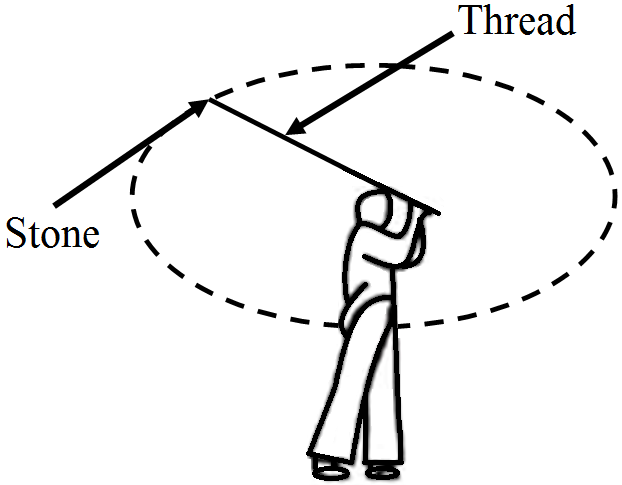
Look at the figure below and answer the following questions:
  1. Name the kind of motion of the stone.
  2. It this an example of accelerated motion? Why?
  3. Name the force that keeps the stone in its path.
  4. What is the direction of this force? Draw it in your answer sheet.