Question
How would you account for the following?
  1. Transition metals exhibit variable oxidation states.
  2. Zr(z=40) and Hf (Z=72) have almost identical redii.
  3. Transition metals and their compounds act as catalyst.
Answer

  1. Due to incomplete filling of d-orbitals, transition metals show variable oxidation states.
  2. Because of Lanthanoid Contraction.
  3. Because of their ability to show multiple/variable oxidation states.

Need a full question paper?

Generate a complete, print-ready paper with questions like this in minutes — across 16+ boards, with answer keys.

Start Generating Free

Similar questions

  1. What is the basis of formation of the spectro-chemical series?
  2. Draw the structures of geometrical isomers of the following coordination complexes:

[Co(NH3)3Cl3] and [CoCl2(en)2]+.

(en = ethylenediamine and atomic number of Co is 27).

List various types of isomerism possible for coordination compounds, giving an example of each.
Give primary information about carbohydrate compounds?
Three electrolytic cells A, B, C containing solutions of ZnSO4, AgNO3 and CuSO4, respectively are connected in series. A steady current of 1.5 amperes was passed through them until 1.45 g of silver deposited at the cathode of cell B. How long did the current flow? What mass of copper and zinc were deposited?
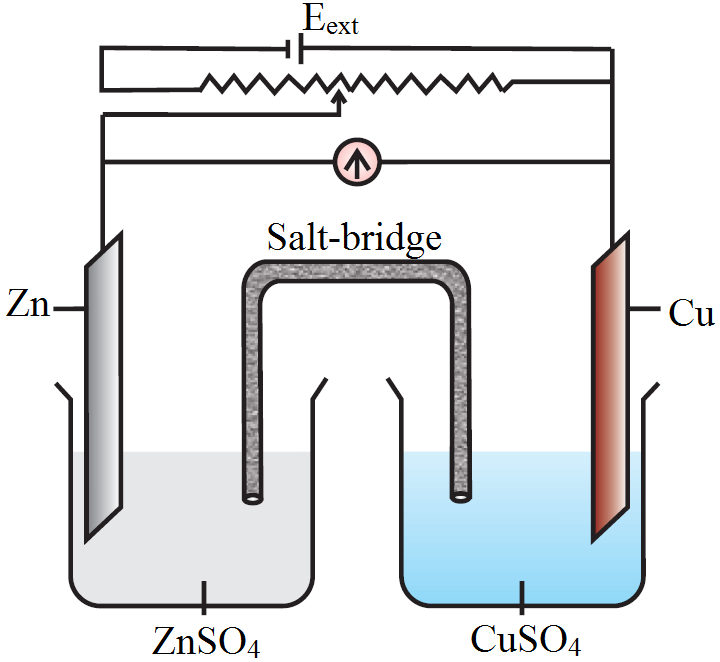
The electrochemical cell given alongside converts the chemical energy released during the redox reaction
$\text{Zn(s) + Cu}^{2+}\text{(aq)}\xrightarrow{ \ \ \ \ \ \ \ }\text{Zn}^{2+}(\text{aq) + Cu(s)}$
to electrical energy. It gives an electrical potential of 1.1V when concentration Zn2+ and Cu2+ ions is unity. State the direction of flow of current and also specify whether zinc and copper are deposited or dissolved at their respective electrodes when:
  1. An external opposite potential of less than 1.1V is applied.
  2. An external potential of 1.1V is applied.
  3. An external potential of greater than 1.1V is applied.

The $\pi$-complexes are known for transition metals only. Why?
What is order of reaction? Discuss elementary and complex reactions, Explain units of rate constant in detail.
Calculate the boiling point of a 1M aqueous solution (density 1.04g mL-1) of potassium chloride (Kb for water = 0.52K kg mol-1, Atomic masses: K = 39u, Cl = 35.5u) Assume, potassium chloride is completely dissociated in solution.
Note on: Cyclic structure of glucose.
Explain why [Fe(H2O)6]3+ has magnetic moment value of 5.92BM whereas [Fe(CN)6]3- has a value of only 1.74BM.