MCQ
Hubble's law is related with
  • A
    Comet
  • Speed of galaxy
  • C
    Black hole
  • D
    Planetary motion

Answer

Correct option: B.
Speed of galaxy
b
(b)Speed of galaxy is proportional to it's distance from us i.e. $U \propto r.$ This is Hubble's law

Need a full question paper?

Generate a complete, print-ready paper with questions like this in minutes — across 16+ boards, with answer keys.
Start Generating Free

Similar questions

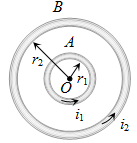
A and B are two concentric circular conductors of centre O and carrying currents $i_1$ and $i_2$ as shown in the adjacent figure. If ratio of their radii is 1 : 2 and ratio of the flux densities at O due to A and B is 1 : 3, then the value of $i_1/i_2$ is

Laser beams are used to measure long distance because
$...X...$ is a machine that can build up high voltages of the order of a few million volts. Here, A refers to:
Four point charges $-q, +q, +q$ and $-q$ are placed on $y$ axis at $y = -2d$, $y = -d, y = +d$ and $y = +2d$, respectively. The magnitude of the electric field $E$ at a point on the $x -$ axis at $x = D$, with $D > > d$, will vary as
Light is incident normally on a diffraction grating through which the first order diffraction is seen at $32^\circ$. The second order diffraction will be seen at
Half-life of a radioactive substance is $20\,minute$ . The time between $20\%$ and $80\%$ decay will be ......... $min$
Two equal charges q of opposite sign separated by a distance 2a constitute an electric dipole of dipole moment p. If P is a point at a distance r from the centre of the dipole and the line joining the centre of the dipole to this point makes an angle θ with the axis of the dipole, then the potential at P is given by (r >> 2a) (Where p = 2qa)
A transformer with efficiency 80% works at 4 kW and 100 V. If the secondary voltage is 200 V, then the primary and secondary currents are respectively
A coil has $L =\, 0.04\, H $and $R = 12\,\Omega $. When it is connected to $220\,V$, $50\,Hz$ supply the current flowing through the coil, in amperes is
The fusion of light elements take place at about the temperatures of about: