MCQ
Hydrocarbon containing following bond is most reactive
  • $C \equiv C$
  • B
    $C = C$
  • C
    $C -C$
  • D
    All of these

Answer

Correct option: A.
$C \equiv C$
a
(a) $ - C \equiv C - $is most reactive because $sp$ - hybridization.

Need a full question paper?

Generate a complete, print-ready paper with questions like this in minutes — across 16+ boards, with answer keys.

Start Generating Free

Similar questions

Acidic ferric chloride solution on treatment with excess of potassium ferrocyanide gives a Prussian blue coloured colloidal species. It is :
On heating a mixture of $SO_2Cl_2$ and $CO$ two equilibria are simultaneously established

$S{O_2}C{l_2}\left( g \right) \rightleftharpoons S{O_2}\left( g \right) + C{l_2}\left( g \right)$

$CO\left( g \right) + C{l_2}\left( g \right) \rightleftharpoons COC{l_2}\left( g \right)$

on adding more $SO_2$ at equilibrium what will happen?

Which of the following is arranged in order of increasing radius?
Calculate the amount of water evaporated if $2.8\ kg$ of $2\ m\ CaBr_2$ solution is heated to $110\,^o\ C$ at $1\ atm$ .......... $gm$

(Given : $K_b$ of water $=0.5\ Kkg/mol$ . ; Atomic mass of $Ca =40$ , $Br =80$)
Based on the value of $B.E.$  given, $\Delta _fH^o$ of  $N_2H_4\,(g)$ is 
Given $: N-N = 159\,\,kJ\,\,mol^{-1}\,;\, H-H = 436\,\,kJ\,\,mol^{-1}$
$N \equiv N\,= \,941\,\,kJ{\kern 1pt} \,mo{l^{ - 1}}; N-H = 398\,\,kJ\,\,mol^{-1}$......$kJ\,\,mol^{-1}$
What is the shape of the $ClF_3$ molecule?
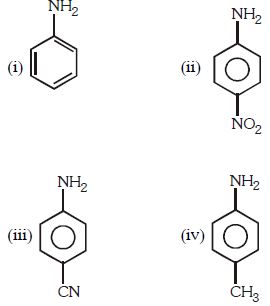
Arrange these compounds in decreasing order of basic strength
Which of the following will show optical isomerism

$(I)$ Cis $-[Co(NH_3)_2(en)_2]^{+3}$

$(II)$ Trans $-[Ir \,Cl_2\, (C_2O_4)_2]^{-3}$

$(III)$ $[Rh(en)_3]^{+3}$

$(IV)$ Cis $-[Ir(H_2O)_3Cl_3]$

$A \rightarrow B$

The above reaction is of zero order. Half life of this reaction is $50\,min$. The time taken for the concentration of $A$ to reduce to one-fourth of its initial value is $...........\min$(Nearest integer)

Which of the following tendencies remains unchanged on going down in the nitrogen family (Group - $V-A$) ?