Question

Hydrogen atom emits blue light when it changes from n = 4 energy level to the n = 2 level. Which colour of light would the atom emit when it changes from the n = 5 level to the n = 2 level

(a) Red

(b) Yellow

(c) Green   

(d) Violet

Answer

(d) Violet

Need a full question paper?

Generate a complete, print-ready paper with questions like this in minutes — across 16+ boards, with answer keys.

Start Generating Free

Similar questions

12 cells each having same emf are connected in series with some cells wrongly connected. The arrangement is connected in series with an ammeter and two cells which are in series. Current is 3 A when cells and battery aid each other and is 2 A when cells and battery oppose each other. The number of cells wrongly connected is

(a) 4 

(b) 1

(c) 3  

(d) 2

Deviation of 5° is observed from a prism whose angle is small and whose refractive index is 1.5. The angle of prism is

(a) 7.5°

(b) 10°

(c) 5°

(d) 3.3°

To compare magnetic moments of two magnets by vibration magnetometer, 'sum and difference method' is better because

(a) Determination of moment of inertia is not needed which minimises the errors

(b) Less observations are required

(c) Comparatively less calculations

(d) All the above

In Bohr’s model, if the atomic radius of the first orbit is  , then the radius of the fourth orbit is

(a)        

(b) 4 

(c)  

(d) 16 

The ratio of the refractive index of red light to blue light in air is

(a) Less than unity

(b) Equal to unity

(c) Greater than unity

(d) Less as well as greater than unity depending upon the experimental arrangement

Doppler's effect in sound in addition to relative velocity between source and observer, also depends while source and observer or both are moving. Doppler effect in light depend only on the relative velocity of source and observer. The reason of this is

(a) Einstein mass - energy relation

(b) Einstein theory of relativity

(c) Photoelectric effect

(d) None of these

If m, mn and mp are the masses of  nucleus, neutron and proton respectively

(a)  

(b)  

(c)  

(d) 

A parallel beam of light is incident on a converging lens parallel to its principal axis. As one moves away from the lens on the other side on its principal axis, the intensity of light:

Light is incident normally on a diffraction grating through which the first order diffraction is seen at 32o. The second order diffraction will be seen at

(a) 48o

(b) 64o

(c) 80o


(d) There is no second order diffraction in this case

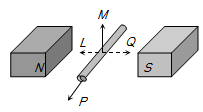
An electric potential difference will be induced between the ends of the conductor shown in the diagram, when the conductor moves in the direction

(a)  P

(b) Q

(c)  L 

(d) M