Question
Hydrogen atom has only one electron, so mutual repulsion between electrons is absent. However, in multielectron atoms mutual repulsion between the electrons is significant. How does this affect the energy of an electron in the orbitals of the same principal quantum number in multielectron atoms?
Answer

The energy of an electron in a hydrogen atom is determined solely by the principal quantum number. Thus, the energy of the orbitals increases as follows:
1s < 2s = 2p < 3s = 3p = 3d < 4s = 4p = 4d = 4f < (2.23),
The energy of an electron in a multielectron atom, that of the hydrogen atom, depends not only on its principal quantum number (shell), but also on its azimuthal quantum number (subshell). That is, for a given principal quantum number, s, p, d, f .... all have different energies.

Need a full question paper?

Generate a complete, print-ready paper with questions like this in minutes — across 16+ boards, with answer keys.

Start Generating Free

Similar questions

How would you react to the statement that the electronegativity of N on Pauling scale is 3.0 in all the nitrogen compounds?
What are the frequency and wavelength of a photon during a transition from $\mathrm{n}=5$ state to $\mathrm{n}=2$ state in the $\mathrm{He}^{+}$ion.
i. Why $\mathrm{BeCO}_3$ kept in atmosphere of $\mathrm{CO}_2$ ?
ii. What happens $\mathrm{Li}_2 \mathrm{CO}_3$ is heated? Give chemical equation.
Standard molar enthalpy of formation, $\Delta_\text{f}\text{H}^\ominus$ is just a special case of enthalpy of reaction, $\Delta_\text{r}\text{H}^\ominus$. Is the $\Delta_\text{r}\text{H}^\ominus$ for the following reaction same as $\Delta_\text{f}\text{H}^\ominus$? Give reason for your answer.$\text{CaO}(\text{s})+\text{CO}_2(\text{g})\rightarrow\text{CaCO}_3(\text{s});$ $\Delta_\text{f}\text{H}^\ominus=-178.3\text{kJ}\ \text{mol}^{-1}$
The value of $\Delta_\text{f}\text{H}^\ominus$ for $NH_3$ is $-91.8kJ mol^{-1}$. Calculate enthalpy change for the following reaction:$2\text{NH}_3(\text{g})\rightarrow\text{N}_2(\text{g})+3\text{H}_2(\text{g})$
Explain the following reactions:
Silicon dioxide is treated with hydrogen fluoride.
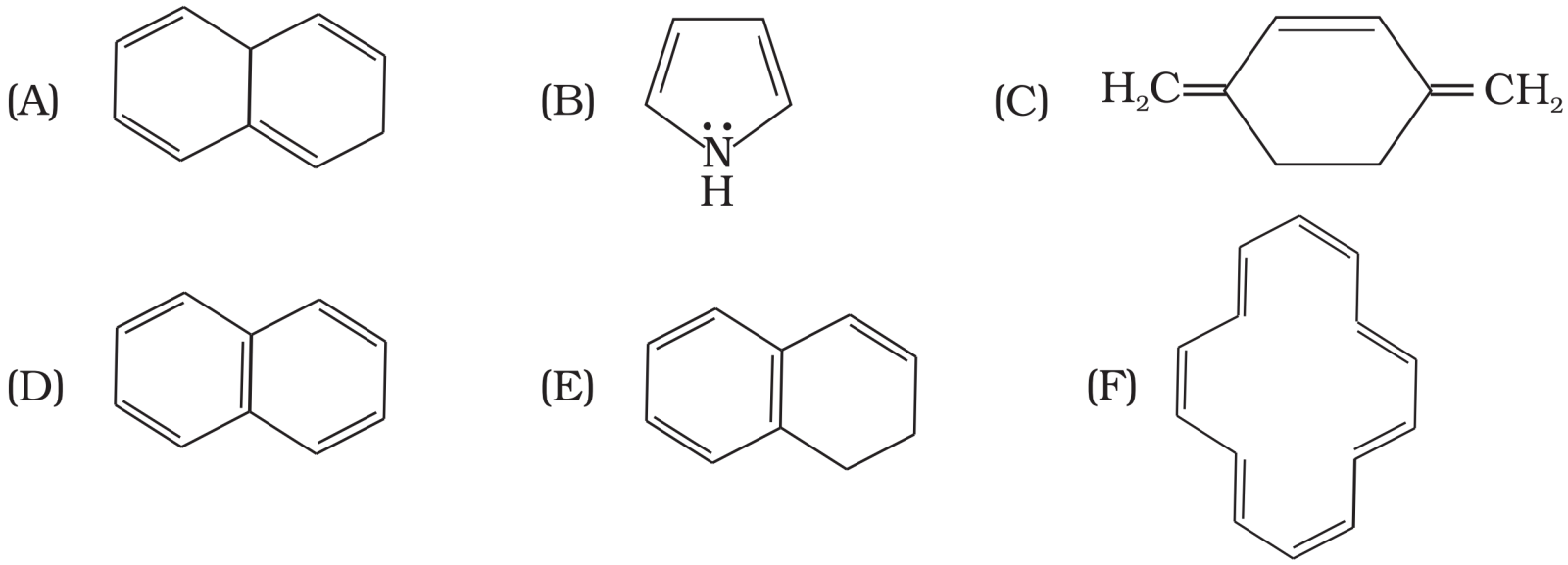
Which of the following compounds are aromatic according to Huckel’s rule?
Calculate the molarity of a solution of ethanol in water, in which the mole fraction of ethanol is 0.040 (assume the density of water to be one).
i. Arrange $\mathrm{NH}_3, \mathrm{PH}_3, \mathrm{AsH}_3, \mathrm{SbH}_3$ in increasing order of boiling point.
ii. Identify complex, interstitial, covalent and polymeric hydrides from the following.
$\mathrm{BeH}_2, \mathrm{AsH}{ }_3, \mathrm{LaH}_3, \mathrm{LiAlH}_4$.
Describe the following in brief:
  1. Ozone depletion over Antarctica (Ozone hole) (do not write reaction).
  2. COD.
  3. Fluoride in tooth paste protects teeth against decay.
Fluorine reacts with ice and results in the change:
$H_2O(s) + F_2(g) → HF(g) + HOF(g)$
Justify that this reaction is a redox reaction.