MCQ
Hydrogen bonding is maximum in
- ✓Ethanol
- BDiethyl ether
- CEthyl chloride
- DTriethyl amine
Hydrogen bonding is observed when $H$ atom is attached to more electronegative $N, F$ or $O$ atom.
Thus, hydrogen bonding is possible in ethanol and triethylamine.
In ethanol, $H$ is attached to a more electronegative oxygen than in
triethylamine, in which $H$ is attached to a less electronegative nitrogen.
Moreover, in triethyl amine, the $+ I$ effect of three methyl groups decreases the extent of hydrogen bonding.
Generate a complete, print-ready paper with questions like this in minutes — across 16+ boards, with answer keys.
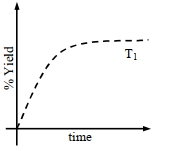
$N _2( g )+3 H _2( g ) \rightleftharpoons 2 NH _3( g ), \Delta H < 0$
at $\left( P , T _1\right)$ is given below:
$Image$
If this reaction is conducted at $\left(P, T_2\right)$, with $T_2>T_1$, the $\%$ yield of ammonia as a function of time is represented by