MCQ
Hysterisis is the phenomenon of lagging of:
  • A
    $I$ behind $B$
  • B
    $B$ behind $I$
  • $I$ and $B$ behind $H$
  • D
    $H$ behind $I$

Answer

Correct option: C.
$I$ and $B$ behind $H$

When we increase $H$ then $I$ also increases but when we decrease $HI$ does not becomes zero, and so as $B$ if we plot BvsH curve instead of IvsH.

Need a full question paper?

Generate a complete, print-ready paper with questions like this in minutes — across 16+ boards, with answer keys.
Start Generating Free

Similar questions

The focal lengths of the objective and eye lenses of a telescope are respectively $200 \,cm$ and $5 \,cm.$ The maximum magnifying power of the telescope will be
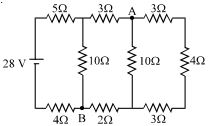
Consider the circuit shown in the figure
Two identical tennis balls each having mass $m$ and charge $q$ are suspended from a fixed point by threads of length $l$. What is the equilibrium separation when each thread makes a small angle $\theta$ with the vertical?
An electromagnetic wave can be produced when the charge is
Huygen wave theory allows us to know
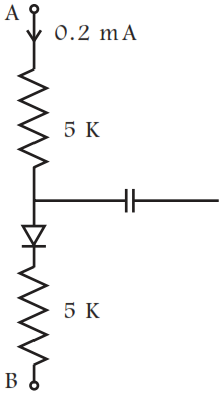
In the circuit shown in Fig., if the diode forward voltage drop is $0.3V,$ the voltage difference between $A$ and $B$ is:
Given below are two statements:

Statement $I :$ Maximum power is dissipated in a circuit containing an inductor, a capacitor and a resistor connected in series with an $AC$ source, when resonance occurs

Statement $II :$ Maximum power is dissipated in a circuit containing pure resistor due to zero phase difference between current and voltage.

In the light of the above statements, choose the correct answer from the options given below :

A proton and an $\alpha - $particle enter a uniform magnetic field perpendicularly with the same speed. If proton takes $25$ $\mu \, sec$ to make $5$ revolutions, then the periodic time for the $\alpha - $ particle would be........$\mu \, sec$
If a charged body is moved in an electric field against the Coulomb force, then $......$?
For electron moving in $n^{th}$ orbit of $H-$atom the angular velocity is proportional to