Question
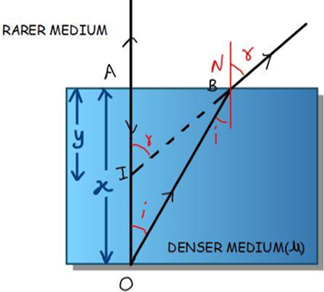
$i$. A coin is placed inside a denser medium. Why does it appear to be raised? Obtain an expression for the height through which the object appears to be raised in terms of refractive index of the medium and real depth.
$ii$. A compound microscope consists of an objective lens of focal length $2 \ cm$ and an eyepiece of focal length $6.25 \ cm$ separated by a distance of $15 \ cm$. How far from the objective should an object be placed in order to obtain the final image at the least distance of distinct vision $(25 \ cm)$ ? Calculate the magnifying power of the microscope.
Answer

$i$. Due to refraction of light
Image
$\text { In } \triangle OAB$
$\sin i =\frac{A B}{O B}$
In $\triangle IAB , \sin r =\frac{A B}{I B}$
According to Snell's law
$\frac{1}{\mu}=\frac{\sin i}{\sin r}=\frac{I B}{O B} $
When angles are small $, OB \approx OA \text { and } IB \approx IA$
$\mu=\frac{O A}{I A}=\frac{x}{y}$
Height through which object is raised $= x - y$
$= x -\frac{x}{\mu}$
$= x \left(1-\frac{1}{\mu}\right)$
$ii. f _0=2 \ cm$
$ f _{ e }=6.25 \ cm$
$L = v _0+\left| u _{ e }\right|=15 \ cm$
$v _{ e }=-25 \ cm$
$\frac{1}{V_e}-\frac{1}{u_e}=\frac{1}{f_e}$
$\frac{1}{-25}-\frac{1}{u_e}=\frac{1}{6.25}$
$u _{ e }=-5 \ cm$
Now, $L=v_0+|-5|=15 \ cm$
$V_o=10 \ cm$
Now $,  \frac{1}{f_o}=\frac{1}{V_o}-\frac{1}{u_o}$
$u _0=2.5 \ cm$
$MP =\frac{V_o}{u_o}\left[1+\frac{D}{f_o}\right]$
$=-20$

Need a full question paper?

Generate a complete, print-ready paper with questions like this in minutes — across 16+ boards, with answer keys.

Start Generating Free

Similar questions

A block of mass M is kept on a rough horizontal surface. The coefficient of static friction between the block and the surface is $\mu.$ The block is to be pulled by applying a force to it. What minimum force is needed to slide the block? In which direction should this force act?
An LR circuit having a time constant of 50ms is connected with an ideal battery of emf $\in.$ Find the time elapsed before:
  1. The current reaches half its maximum value.
  2. The power dissipated in heat reaches half its maximum value.
  3. The magnetic field energy stored in the circuit reaches half its maximum value.
Find the maximum magnifying power of a compound Microscope having a 25 diopter lens as the objective, a 5 diopter lens as the eyepiece and the separation 30cm between the two lenses. The least distance for clear vision is 25cm.
A U-shaped wire is placed before a concave mirror having radius of curvature 20cm. Find the total length of the image.
Show that the magnetic field B at a point in between the plates of a parallel-plate capacitor during charging is $\frac{\in_0{\mu}_\text{r}}{2}\frac{\text{dE}}{\text{dt}}$ (symbols having usual meaning).
  1. A point object is placed on the principal axis of a convex spherical surface of radius of curvature R, which separates the two media of refractive indices $n_1$ and $n_2(n_2 > n_1)$. Draw the ray diagram and deduce the relation between the object distance (u), image distance (v) and the radius of curvature (R) for refraction to take place at the convex spherical surface from rarer to denser medium.
  2. A converging lens has a focal length of 20 cm in air. It is made of a material of refractive index 1.6. If it is immersed in a liquid of refractive index 1.3, find its new focal length.
A capacitor of capacitance C is given a charge Q. At t = 0, it is connected to an uncharged capacitor of equal capacitance through a resistance R. Find the charge on the second capacitor as a function of time.
Find the charge required to flow through an electrolyte to liberate one atom of.
  1. A monovalent material.
  2. A divalent material.
Can static friction do nonzero work on an object? If yes, give an example. If no, give reason.
A block of mass 2.0kg kept at rest on an inclined plane of inclination 37° is pulled up the plane by applying a constant force of 20N parallel to the incline. The force acts for one second.
  1. Show that the work done by the applied force does not exceed 40J.
  2. Find the work done by the force of gravity in that one second if the work done by the applied force is 40J.
  3. Find the kinetic energy of the block at the instant the force ceases to act. Take $g = 10m/s^2.$