Question
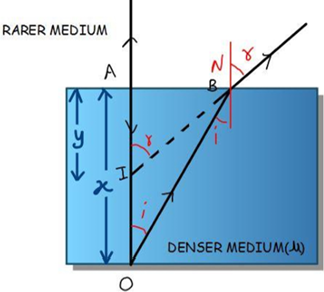
i. A coin is placed inside a denser medium. Why does it appear to be raised? Obtain an expression for the height through which the object appears to be raised in terms of refractive index of the medium and real depth.
ii. A compound microscope consists of an objective lens of focal length 2 cm and an eyepiece of focal length 6.25 cm separated by a distance of 15 cm. How far from the objective should an object be placed in order to obtain the final image at the least distance of distinct vision (25 cm)? Calculate the magnifying power of the microscope.
Answer

i. Due to refraction of light
Image

$\begin{array}{l}\text { In } \triangle OAB \\
\sin i =\frac{A B}{O B}\end{array}$
In $\triangle IAB , \sin r =\frac{A B}{I B}$
According to Snell's law
$\begin{array}{l}\frac{1}{\mu}=\frac{\sin i}{\sin r}=\frac{I B}{O B} \text { When angles are small, } OB \approx OA \text { and } IB \approx IA \\
\mu=\frac{O A}{I A}=\frac{x}{y}\end{array}$
Height through which object is raised = x - y
$\begin{array}{l}= x -\frac{x}{\mu} \\
= x \left(1-\frac{1}{\mu}\right)\end{array}$
ii. $f _0=2 cm$
$\begin{array}{l} f _{ e }=6.25 cm \\
L = v _0+\left| u _{ e }\right|=15 cm \\
v _{ e }=-25 cm\end{array}$
$\begin{array}{l}\frac{1}{V_e}-\frac{1}{u_e}=\frac{1}{f_e} \\
\frac{1}{-25}-\frac{1}{u_e}=\frac{1}{6.25} \\
u _{ e }=-5 cm\end{array}$
Now, $L=v_0+|-5|=15 cm$
$V_o=10 cm$
$\begin{array}{l}\text { Now, } \frac{1}{f_o}=\frac{1}{V_o}-\frac{1}{u_o} \\
u _0=2.5 cm \\
MP =\frac{V_o}{u_o}\left[1+\frac{D}{f_o}\right] \\
=-20\end{array}$

Need a full question paper?

Generate a complete, print-ready paper with questions like this in minutes — across 16+ boards, with answer keys.

Start Generating Free

Similar questions

Figure shows a cylindrical tube with adiabatic walls and fitted with an adiabatic separator. The separator can be slid into the tube by an external mechanism. An ideal gas $(\gamma=1.5)$ is injected in the two sides at equal pressures and temperatures. The separator remains in equilibrium at the middle. It is now slid to a position where it divides the tube in the ratio 1 : 3. Find the ratio of the temperatures in the two parts of the vessel.

Define various types of magnetism on the basis of atomic model of magnetisation.
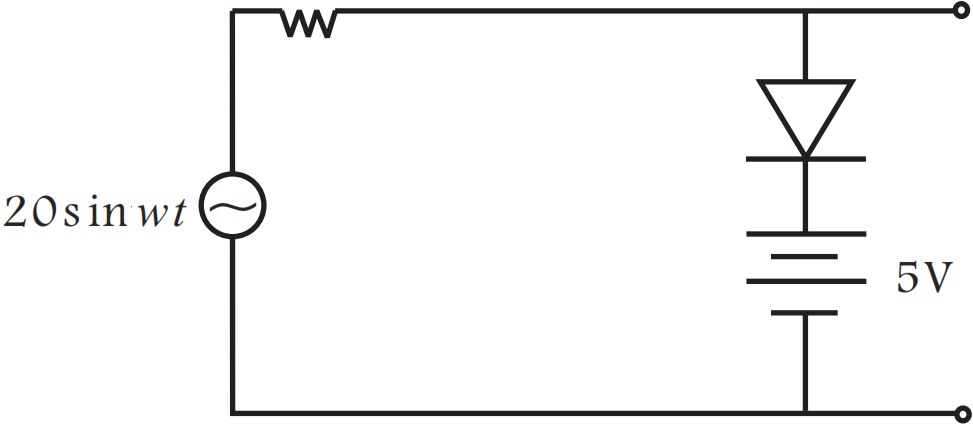
Assuming the ideal diode, draw the output waveform for the circuit given in Fig. Explain the waveform.

In an experiment to measure the speed of light by Fizeau's apparatus, following data are used:
Distance between the mirrors = 12.0km,
Number of teeth in the wheel = 180.
Find the minimum angular speed of the wheel for which the image is not seen.
Light is incident from glass $(\mu=1.50)$ to water $(\mu=1.33).$ Find the range of the angle of deviation for which there are two angles of incidence.
An ideal gas is trapped between a mercury column and the closed-end of a narrow vertical tube of uniform base containing the column. The upper end of the tube is open to the atmosphere. The atmospheric pressure equals 76cm of mercury. The lengths of the mercury column and the trapped air column are 20cm and 43cm respectively. What will be the length of the air column when the tube is tilted slowly in a vertical plane through an angle of 60°? Assume the temperature to remain constant.
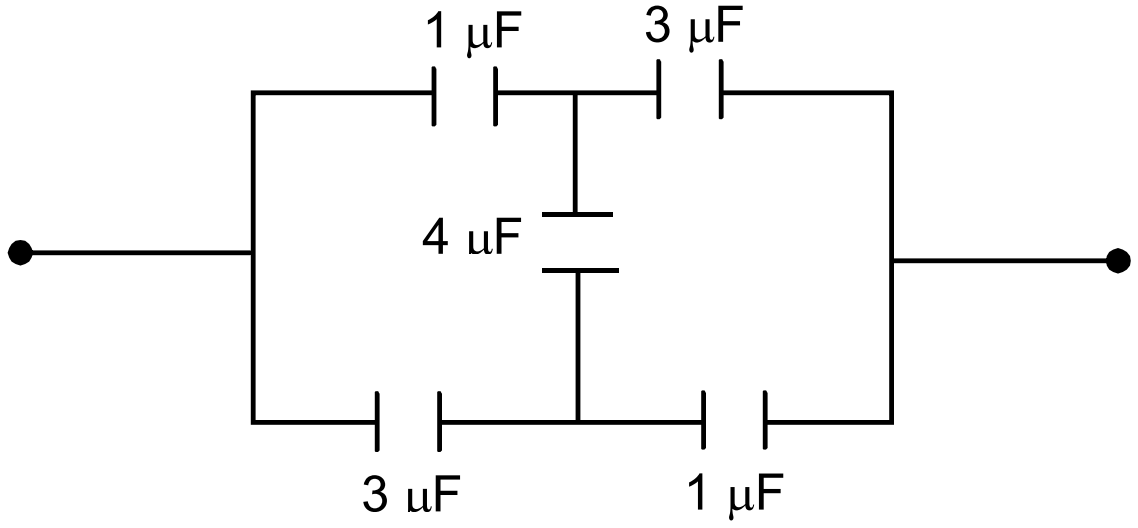
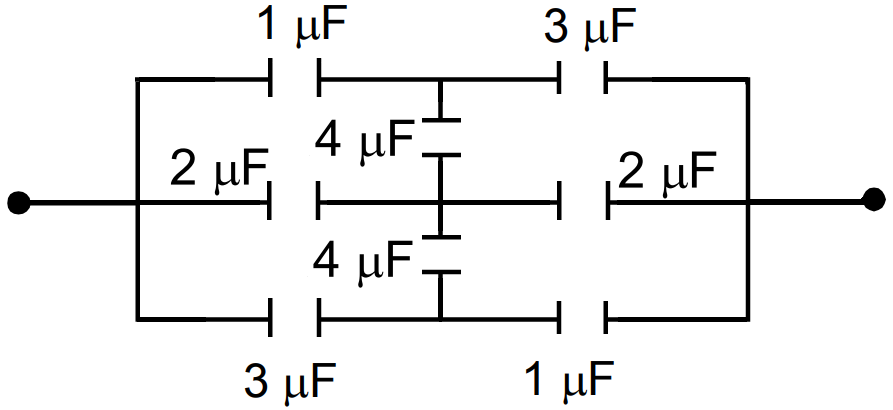
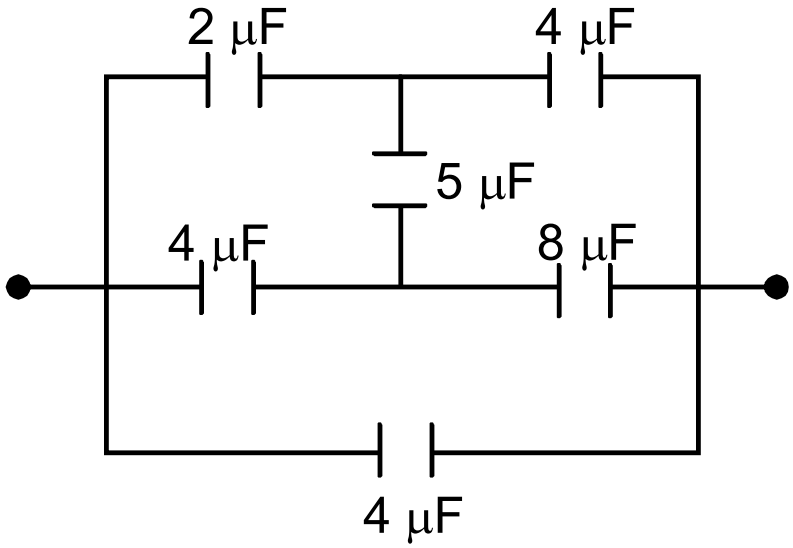
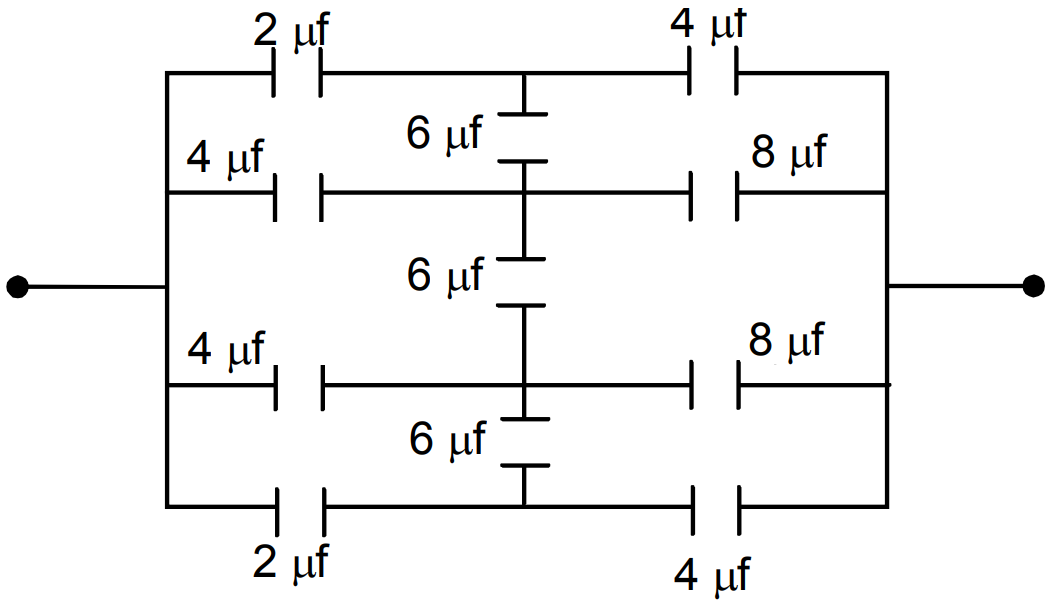
Find the equivalent capacitances of the combinations shown in figure between the indicated points.


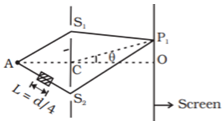
A small transparent slab containing material of $\mu=1.5$ is placed along $AS _2$ (Figure). What will be the distance from O of the principal maxima and of the first minima on either side of the principal maxima obtained in the absence of the glass slab?
Image

$AC = CO = D , S _1 C = S _2 C = d < D$
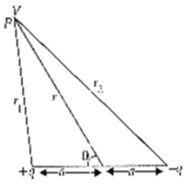
Derive an expression for potential due to a dipole for distances large compared to the size of the dipole. How is the potential due to dipole different from that due to a single charge? 
Image
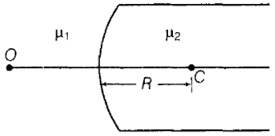
Figure shows a convex spherical surface with centre of curvature $C$ separating the two media of refractive indices $\mu_1$ and $\mu_2$. Draw a ray diagram showing the formation of the image of a point object $O$ lying on the principal axis. Derive the relationship between the object and image distance in terms of refractive indices of the media and the radius of curvature R of the surface.
Image