Question
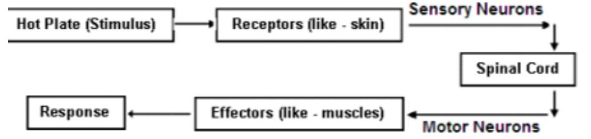
i. Define a reflex arc. Why have reflex arcs evolved in animals? Trace the sequence of events which occur, when you suddenly touch a hot object.
ii. Name the part of nervous system which helps in communication between the central nervous system and other parts of the body. What are the two components of this system?
Answer

i. The pathway in which impulses travel during the reflex action is called a reflex arc. Because the thinking part of the brain is not fast enough/for quick response to avoid injury. Reflex arc:
Image
ii. Peripheral Nervous System
Components: Cranial Nerves; Spinal Nerves

Need a full question paper?

Generate a complete, print-ready paper with questions like this in minutes — across 16+ boards, with answer keys.

Start Generating Free

Similar questions

Nerves and hormones both are used to control processes within the body. Using examples, show how nervous control and hormonal control.
  1. Resemble and.
  2. Differences from one another.
What are the methods used by plants to get rid of their waste products?
A food chain consists of fish, larvae, phytoplanktons and birds. The level of pesticides in water in which the fish, larvae and phytoplanktons live is quite high.
  1. In which organisms the pesticides enter from the polluted water? What is this level of organisms known as?
  2. Which organism will have the maximum amount of pesticides accumulated through the food chain? What is this process known as?
  3. Write the food chain comprising all the organisms mentioned above.
  4. Which other organism you could write in place of bird in the above food chain?
  1. With the help of a suitable circuit diagram prove that the reciprocal of the equivalent resistance of a group of resistances joined in parallel is equal to the sum of the reciprocals of the individual resistances.
  2. In an electric circuit, two resistors of $12\Omega$ each are joined in parallel to a 6V battery. Find the current drawn from the battery.
Explain how, sex is determined in human babies.
With the help of a labelled diagram, illustrate the pathway of response when someone pricks in your hand with a pin.
Describe the working of an AC generator with the help of a labeled circuit diagram. What changes must be made in the arrangement to convert it to a DC generator?
A compound$ A ($molecular formula $C_3H_6O_2)$ reacts with sodium metal to form compound B and evolves a gas which burns with a pop sound. The compound $A$ on treatment with alcohol $C,$ found in beer$,$ in presence of concentrated sulphuric acid$,$ forms a sweet smelling compound $D ($molecular formula $C_5H_{10}O_2)$. On addition of $\text{NaOH}$ to $A$ it also gives $B$ and water. $D$ on treatment with $\text{NaOH}$ gives back $B$ and $C.$ Identify $\text{A, B, C}$ and $D$ and write down the chemical equations of the reactions involved.
The partially digested food coming from the stomach of a person enters a long and narrow organ A in his body. The organ A receives the secretion of two glands: liver and pancreas. Liver secretes a greenish - yellow liquid B which is normally stored in the organ C. Pancreas secretes pancreatic juice which contains three digestive enzymes D, E and F. The intestinal juice completes the process of digestion of food. The inner wall of organ A has millions of tiny finger - like projections G which help in the rapid absorption of digested food into blood stream. The undigested part of food then passes into wider tube H which absorbs most of the water from undigested food. The last part of tube H called I stores this undigested food (or waste) for some time. The undigested food is then passed out though opening J as faeces in the process known as K.
  1. Name the organ A.
  2. Name liquid B and organ C.
  3. What are the digestive enzymes D, E and F?
  4. Name the projections G present on the inner wall of organ A.
  5. Name Tube H, Part I, Opening J and Process K.
A small part of the shoot of a plant is removed with a sharp knife. When the lower end of this small part of the shoot is buried in moist soil, it gradually develops roots and shoots and grows to become a new plant.
  1. What is the name of this method of propagating plants?
  2. What care should be taken while removing a small part of the shoot from the parent plant with a knife?
  3. Name any two plants which provide us with food directly or indirectly and are grown by this method.
  4. Give one advantage of this method of producing new plants.
  5. State whether it is a sexual method of reproduction or an asexual method. Why?
  6. What special name can be given to the genetically identical new plants produced by this technique?