Question
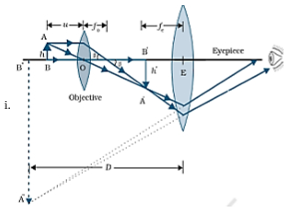
$i$. Draw a ray diagram showing the image formation by a compound microscope. Hence obtain the expression for total magnification when the image is formed at least distance of distinct vision.
$ii$. A compound microscope consists of an objective lens of focal length $2.0 \ cm$ and an eyepiece of focal length $6.0 \ cm$. If they are separated by a distance of $24 \ cm,$ find the total magnification when the image is formed at infinity.
Answer

Image

Magnification due to objective
$m_0=\frac{h^{\prime}}{h}=\frac{L}{f_0}\left(\because \tan \beta=\frac{h}{f_0}=\frac{h}{L}\right)$
Magnification due to eye piece when final image is formed at the near point
$m _{ e }=1+\frac{D}{f_{ e }}$
Total magnification
$ m = m _0 m_{ e }$
$m =\frac{L}{f_0}\left(1+\frac{D}{f_{ e }}\right)$
$ii. 4$
$m=\frac{L D}{f_o f_e}$
$m=\frac{24 \times 25}{2 \times 6}$
$=\frac{600}{12}$
$=50$
Hence, the total magnification when the image is formed at infinity is $50$.

Need a full question paper?

Generate a complete, print-ready paper with questions like this in minutes — across 16+ boards, with answer keys.

Start Generating Free

Similar questions

A charge of $8 \ mC$ is located at the origin. Calculate the work done in taking a small charge of $–2 \times 10^{–9} C$ from a point $P (0, 0, 3 \ cm)$ to a point $Q (0, 4 \ cm, 0),$ via a point $R (0, 6 \ cm, 9 \ cm)$.
Clear the difference between interference and diffraction.
A stone is thrown vertically upward with a speed of $28m/s.$
  1. Find the maximum height reached by the stone.
  2. Find its velocity one second before it reaches the maximum height.
  3. Does the answer of part.
  4. Change if the initial speed is more than $28m/s$ suchas $40m/s$ or $80m/s$?
In a series $\text{LCR}$ circuit with an $\text{AC}$ source, $\text{R}=300\Omega,\text{C}=20\mu\text{F},\text{L}=1.0\text{ henry},\epsilon_0=50\text{V}$ and $\nu=\frac{50}{\pi}\text{Hz}.$ Find:
  1. The rms current in the circuit.
  2. The rms potential difference across the capacitor, the resistor and the inductor. Note that the sum of the rms potential differences across the three elements is greater than the rms voltage of the source.
What is electric dipole? Find and expression for electric potential at any point due to an electric dipole.
Using the Bohr's model, calculate the speed of the electron in a hydrogen atom in the n = 1 2, and 3 levels.
A current of $1.0A$ exists in a copper wire of cross$-$section $1.0\ mm^2$. Assuming one free electron per atom, calculate the drift speed of the free electrons in the wire. The density of copper is $9000\ kg/m^{-3}.$
Write the expression for the force, $\vec{\text{F}}$ acting on a charged particle of charge ‘q’, moving with a velocity $\vec{\text{v}}$ in the presence of both electric field $\vec{\text{E}}$ and magnetic field $\vec{\text{B}}$. Obtain the condition under which the particle moves undeflected through the fields.
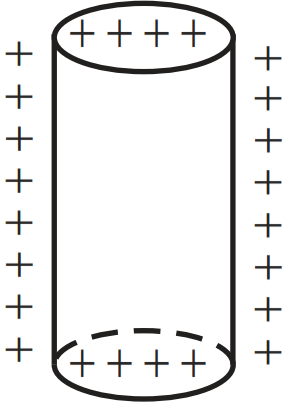
Sketch the electric field lines for a uniformly charged hollow cylinder shown in Fig.
A parallel$-$plate capacitor has plate area $25.0\ cm^2$ and a separation of $2.00\ mm$ between the plates. The capacitor is connected to a battery of $12.0V:$
  1. Find the charge on the capacitor.
  2. The plate separation is decreased to $1.00\ mm$. Find the extra charge given by the battery to the positive plate.